
Germany: Protesters of Elbit arms industry jailed
April 10, 2026
Ignacio Rosaslanda of the German daily newspaper, junge Welt, conducted a 20-minute-long video with Mimi, the mother, and Clara, the sister, of Daniel, one of the five prisoners known as the Ulm 5, and with Josie, the partner of V., another prisoner. The defendants were arrested last September after a protest of the notorious Israeli-based corporation Elbit at their building in Ulm. The interview was conducted in English. It’s available here: jungewelt.de. For background on Elbit and protests held in the United States, see workers.org. Translation of the April 5 jW article: John Catalinotto.
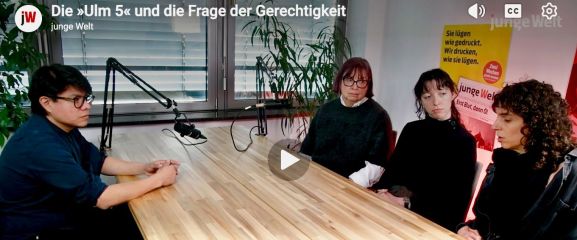
Ignacio Rosaslanda of junge Welt interviews Mimi, the mother, and Clara, the sister of Daniel, one of the five prisoners known as the Ulm 5, and Josie, the partner of V., another of the defendants. Credit: jW
Elbit supplies the weapons and surveillance technology that the Zionist occupation forces used and are using in their ongoing genocide of Palestine and their assault on Lebanon and Iran.
This interview covers the case of the so-called Ulm 5, a group of activists currently in pretrial detention. They are accused of breaking into an Elbit Systems weapons factory in Ulm. The trial against philosophy student David, queer activist V., and the three other defendants begins on April 27 in Stuttgart. In the conversation, V.’s partner, Josie, as well as Daniel’s mother and sister, speak out and share their perspectives.
All five defendants face the same charges, including property damage and alleged membership in a criminal organization. The break-in at the factory is framed within the context of protests against the genocide in Gaza.
Since their arrest, the five have been held in custody under very strict conditions, which their relatives criticize as disproportionate — including extended pretrial detention, isolation, extensive surveillance, and severe restrictions on visits and communication. For example, Daniel’s mother recounts that for months he was not allowed any direct physical contact with relatives or with other people at all.
In addition to the specific case, the interview also explores the broader political dimension. The interviewees criticize the increasing restrictions on protest opportunities in Germany as well as the repressive treatment of pro-Palestinian activism. With respect to the upcoming trial, they express concerns regarding fairness. At the same time, they paint a personal portrait of Daniel and V. as creative, committed individuals who advocate for social justice out of conviction.


You must be logged in to post a comment.