

By Betsey Piette
June 20, 2026
On June 12, U.S. District Judge Angel Kelley gave President Donald Trump’s administration 21 days to restore any dismantled or altered contents at multiple National Parks Service sites across the U.S. The order includes the President’s House in Philadelphia, which was awaiting a Third U.S. Circuit Court of Appeals ruling regarding Trump’s appeal of a February lawsuit filed by the city of Philadelphia.

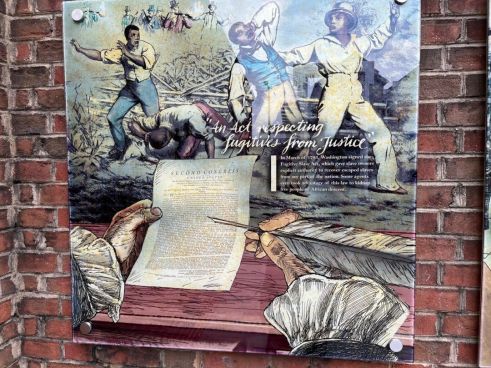
Depiction shown of George Washington signing the Fugitive Slave Act. Posse of white men with clubs and guns shown in panel background shooting at four Black men escaping from enslavement. (Photo: Betsey Piette)
In May 2025, all 433 National Park Service (NPS) installations and other Interior Department holdings were given a mid-September 2025 deadline to “rid exhibits, signs, films and bookstores of statements and literature” that Trump and Secretary of the Interior Douglas Burgum determined unduly focused on “how bad slavery was.” (New York Times, Aug. 19, 2025)
But the NPS sites under attack were not limited to exposing how horrific enslavement was. They included displays concerned with climate change at Fort Sumter, South Carolina, Indigenous history and resistance at the Grand Canyon and at Acadia National Park in Maine, as well as resistance by women and immigrants to capitalism’s exploitation of their labor in Lowell, Massachusetts.
In a more recent attack, in the dark of night on Feb. 10, NPS personnel outrageously removed Stonewall Park’s historic Pride flag, designed by artist Gilbert Baker. They replaced the Progress Pride flag with the U.S. flag, using it as a prop in the effort to erase LGBTQIA2S+ history and the Stonewall Rebellion of 1969. A community struggle successfully fought to have it restored.
In her decision, Kelley, the first African American woman to serve as a federal judge in Massachusetts, wrote: “Because defendants deemed it important to strip the parks of these undeniable truths in anticipation of the 250th anniversary of our great nation, it is equally important that our shared history be honestly told and fully restored by the 250th anniversary to properly honor the remarkable achievements of the United States.” (Jurist News, June 14)
Tribute to enslaved Africans’ history
In 2002, the Liberty Bell in Philadelphia was moved to the northwest side of Independence Park at Sixth and Market streets, where the first “White House” — occupied by Presidents George Washington from 1790 to 1797 and John Adams from 1797 to 1800 — was located. Built by Robert Morris, a financier of the Revolutionary War who profited from the slave trade, the house was torn down and its foundation covered in 1832.
While historians were aware that Washington enslaved 316 people at his Mount Vernon plantation in Virginia, lesser known was that Washington brought nine enslaved Africans to Philadelphia, where slavery was illegal. The new location also held burial grounds with remains of the Africans enslaved by Washington.
In response to the NPS decision to relocate the Liberty Bell, while ignoring the full history of the site, including the areas where the nine enslaved individuals were quartered behind Washington’s house, Avenging the Ancestors Coalition (ATAC), lead by progressive Black attorney Michael Coard, organized, fought, protested, held meetings and demonstrated. ATAC compelled the Independence National Historic Park (INHP) to agree to the creation of a prominent Slavery Memorial to highlight the President’s House project.
Funded by Philadelphia and federal money, the President’s House Site was opened in 2010 and transferred to NPS ownership in 2015. During construction of the site, archeologists involved in the excavation explained the site’s history to a steady stream of people passing by, pointing out where the nine Africans worked and lived and how their activities were hidden from anyone walking by the house on Market Street.
Before they were ordered removed by the NPS in January 2026, one of the panels highlighted Washington’s signing of the infamous 1793 Fugitive Slave Act that put those who escaped enslavement at risk of recapture for the rest of their lives. Artwork on this display shows Washington’s hands holding a quill signing the Act, with a posse of white men with clubs and guns in the background shooting at four Black men escaping from enslavement. After this act was signed, Ona Judge, one of the nine Africans enslaved by Washington, successfully escaped in 1796.
Another panel on Trump’s targeted list focused on the contradictory coexistence of liberty (for whites) and enslavement for Africans. The panel, called “Life Under Slavery,” illustrates the whippings, deprivation of food, clothing and shelter, beatings, torture and rapes endured by enslaved people. On Trump’s removal list was the panel “The Dirty Business of Slavery,” which described the U.S. Constitution’s failure to outlaw slavery, including the designation of enslaved individuals as three-fifths of a person and a graphic depiction of the trans-Atlantic slave trade.
As part of Trump’s blatant attempt to erase the history of enslavement in the U.S., on Jan. 27, NPS workers were ordered to remove 34 panels from the exhibit. The city of Philadelphia challenged Trump’s actions in federal court on Jan. 30 in a lawsuit against the Interior Department and the Park Service.
On Feb. 16, U.S. District Judge Cynthia Rufe ordered the NPS to restore the exhibit on enslavement, giving them until Feb. 20 to comply. Blocking the full restoration of the remaining panels for the duration of Trump’s appeal, an hour before the Feb. 20 deadline, Judge Thomas Hardiman of the Third U.S. Circuit Court of Appeals overruled Rufe’s order to comply with the injunction.
Whitewashing U.S. history
In an ongoing effort by the Trump administration to whitewash U.S. history, on April 8, the National Park Service uploaded renderings of 11 proposed revisionist new panels for the President’s House exhibit. The proposed new panels sought to sanitize Washington’s role as the enslaver of nine individuals at the first “White House” by putting the first U.S. president in a more sympathetic light.
Trump’s effort to sanitize Washington’s role includes panels with statements like: “Slaves living in the President’s House experienced a greater modicum of autonomy than elsewhere in the South such as to explore the city and sometimes even attend the theater, with Washington buying the tickets.”
Trying to portray Washington more favorably, the same panel titled “Presidents Washington and Adams on Slavery” reads: “Caught between his private doubts about slavery and his public responsibility as president, George Washington navigated a nation deeply divided over slavery. … Privately, George Washington often expressed discomfort with the institution and a desire to see it abolished, yet as a Virginia plantation owner, his wealth and livelihood were deeply tied to it.”
Two of the proposed new panels titled “Celebrating Independence Throughout the Years” detail milestones the administration felt worthy of note, including the Union Army in the Civil War and the role they claim Christianity played in the abolition movement. What’s left out, among many things, is the importance of the artifacts related to enslavement that were found during the archaeological dig, especially in the basement where the nine people enslaved by Washington to serve him while he was living in the President’s House in Philadelphia carried out tasks.
In a press release issued April 9, ATAC called the proposed changes unacceptable, “deeply offensive” and “yet another troubling attempt to distort and censor American history.”
Activists fighting to restore the real history of resistance by Indigenous people, enslaved Africans and immigrant workers in the U.S. can appeal to the courts, but one should not become complacent and rely on judges appointed by capitalist politicians, including Trump. As repeatedly seen, Trump will appeal progressive court rulings, hoping the decisions will end up in the U.S. Supreme Court, where his appointees have ruled in his favor more often than not. The struggle must be kept in the streets.
Dismantling historic monuments depicting class struggles will not eradicate the history of over 400 years of racism, colonialism, white supremacy and imperialism in the U.S. It won’t change the fact that Indigenous peoples, enslaved Africans, workers, immigrants and LGBTQIA2S+ activists organized, fought back and continue to resist, often together.


