

July 2, 2026

Fausto Giudice
The author, Jorge Figueiredo, is a Portuguese economist born in Brazil in 1944, a gas technician who specializes in energy analysis and editor of the website resistir.info. The article was translated by Fausto Giudice of Tlaxcala and faustounsi.substack.com and revised for U.S. readers by John Catalinotto.
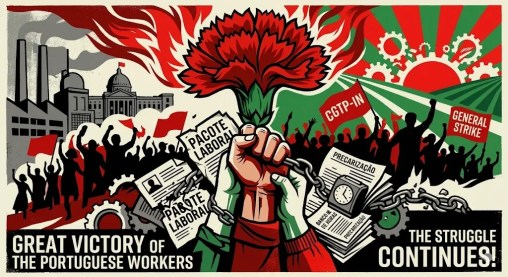
June 20 — June 19, 2026, marked a major victory for Portuguese workers. On that day, the “Pacote Laboral” [“Labor Package”] bill that the forces of capital were trying to impose was defeated in parliament. It was rejected not only in parliament, but, above all, on the streets.
Two general strikes — in December 2025 and June 2026 — were needed to achieve this victory, with demonstrations across the country led by CGTP-IN, the country’s main trade union confederation.
For a non-Portuguese reader, the context needs explaining. The great conquests of the Portuguese Revolution of April 25, 1974 — land reform, nationalization of banks and large monopolistic groups, creation of a state-owned business sector, social and labor rights, etc. — were gradually reversed through a slow-motion counterrevolution that began with the coup of Nov. 25, 1975. The 1976 Constitution itself, which enshrined these conquests, underwent numerous amendments over this period by the forces of reaction (led by the party that presents itself as “socialist”).
This reversal is also reflected in the media, now transformed into outlets for disinformation and debasement, dominated by just five or six groups that control everything (TV, radio, newspapers, magazines). Today, most of the Portuguese economy is dominated by five superrich families (Soares dos Santos, Azevedo, Amorim, Queiroz Pereira and Mota).
The slide back to the pre-April Revolution past has been carried out by the traditional right-wing parties (PSD, CDS and PS). However, in the last legislative elections, the slide intensified with the rise of a new far-right party (Chega) which won a significant parliamentary seat.
Chega is led by a lawyer with ties to Opus Dei [a right-wing organization within the Catholic Church] and has no qualms about using the most populist and xenophobic demagogy. Its electoral base is the lumpenproletariat, precarious workers, the marginalized and segments of the police forces.
Thus, conditions seemed ripe for what capital had always coveted over 50 years: to put an end to the last remnants of the April Revolution’s conquests in labor legislation as well. The reactionary government of Prime Minister Luis Montenegro (a lawyer linked to casinos) and his Labor Minister Maria do Rosário Palma Ramalho (a woman from the financial elite with a personal net worth of €5.3 million/over $6 million) attempted the final blow: a “Labor Package” designed to revert working conditions to those of the 19th century.
The now-defeated package was aimed above all at achieving even greater job insecurity. Here are some of the measures it advocated:
- Legalization of dismissals without just cause
- Outsourcing in order to lower wages
- Limiting flexible hours for mothers and fathers with minor children
- Extending the duration of precarious contracts
- Creation of a time-bank system, with 150 free hours for the employer
- Forcing mothers and fathers with minor children to work night shifts and weekends
- The political representatives of the ruling class and their ideologues said, in all seriousness, that such measures were intended to “make the Portuguese economy more flexible.”
Portugal has one of the lowest minimum wages in Europe (€920/slightly over $1,000 per month), an average wage that is increasingly close to the minimum and old-age pensions below the minimum wage. All this creates a perverse situation in the Portuguese economy: the export of young and reasonably skilled labor and, at the same time, the import of labor from more underdeveloped countries (from Africa, Bangladesh, India, Pakistan, Vietnam, etc.).
Incidentally, imported workers suffer atrocious conditions, with absolute job insecurity (which makes the demagogic xenophobia of the Chega party even more absurd).
The consequences of this situation are worsening and cumulative. For workers, there is a continued poor distribution of national income: only a few monopolistic groups and multinationals continue to hold the lion’s share of national wealth. For the country as a whole, there is near economic stagnation, with paltry GDP (gross domestic product) growth rates in recent years (0.9% in 2025). The dominance of capital leads to stagnation, despite all the transfers from EU (European Union) funds (which end up in few hands).
In summary: The victory won on 19 June was the defeat of the most maximalist offensive of the ruling class. However, it is still the ruling class that is on the offensive. The struggle must continue.


Portuguese workers’ struggles stop anti-labor bill. Lisbon, June 19.


