
March against neo-colonialism and for Puerto Rican independence
By Ferdinand J. Almodovar
August 18, 2026
A community coalition of the Puerto Rican diaspora held a demonstration in front of Lincoln Hospital in the South Bronx, a location long associated with the Puerto Rican struggle in New York City, on Aug. 16. With audio enhancement such as bullhorns, the organizers spoke of its significance historically and currently with prescient comparisons to the generational and ongoing struggle for Puerto Rican independence, civil rights and self-determination. People then marched for Puerto Rican Independence, ending with a second gathering and rally at St. Mary’s Park.
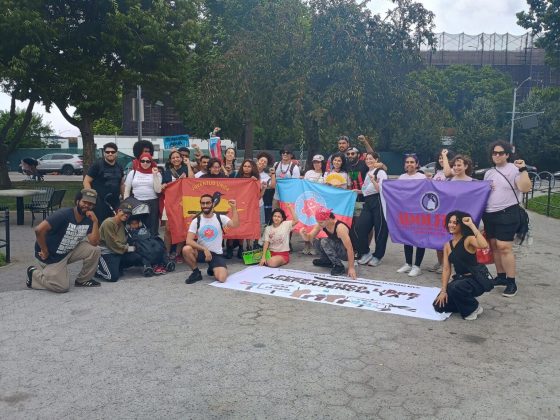
Bronx, New York, Aug. 16, 2026. (Photo: Ferdinand Almodovar)
The neoliberal Financial Oversight and Management Board for Puerto Rico — known as La Junta — along with U.S. military and colonial governance — represented by the current governor of Puerto Rico, Jennifer González-Colón — continues to harm Puerto Rican citizens, migrants and working-class families. This includes recent water rationing imposed in the wake of drought and a months-long water crisis due to broken and unrepaired infrastructure.
La Junta was a significant development under the neo-colonial PROMESA Act instituted by then-President Barack Obama 10 years ago. It has been reduced by the current administration of President Donald Trump to essentially one man with sole authority over the board, John E. Nixon, a Utah-based business executive and Washington insider of the Republican Party.
In the aftermath of one crisis after another for decades and the influx of billionaire firms seeking a tax-free paradise exclusive to themselves and their clientele, the island archipelago of Puerto Rico has suffered unprecedented resource extraction, privatization and sale of public land, such as the Esencia project in Cabo Rojo now being challenged.
It is against the backdrop of this reality for Puerto Rico — the rise of militarized policing and fascist terror against the people of Puerto Rico and the systematic degradation of entire cities and communities down to the institutional level during Black August of 2026 — that these organizers gathered in the New York City diaspora.
They rallied and marched for Puerto Rican liberation and the liberation of all peoples suffering and struggling under the yoke of imperialistic destruction and colonialism across the world, most urgently women, children and other vulnerable groups targeted by state violence and proxy actors.
Speakers included both Puerto Rican community leaders as well as allies in full solidarity from African-American, Haitian, Filipino and other communities. Organizations included ProLibertad FC, JUPI (Juventud Unida Por La Independencia/Youth United For Independence), Call To Action On Puerto Rico, Adolfina, The Diaspora Pa’lante Collective, Black Alliance For Peace, and PIP (Partido Independentista Puertorriqueño/The Puerto Rican Independence Party).
Rally features music and solidarity
The rally in St. Mary’s Park included Bomba, a culturally significant and celebrated ancestral folk music of Boriken, and additional speakers demanding justice for the Puerto Rican people and the diaspora, as well as for Haiti and Haitians living under threat of deportation from the Trump Administration’s Immigration and Customs Enforcement (ICE) and Customs and Border Patrol (CBP) terror campaign.
Speakers condemned U.S. colonial and neo-colonial crimes in the Philippines and called for international solidarity against actions of the U.S. imperialistic war machine, such as the looming threat of war and worsening sanctions against Cuba and the kidnapping of Venezuela President Nicolas Maduro and First Combatant Cilia Flores, currently held in federal Metropolitan Detention Center (MDC) in Brooklyn, New York.
The parallels between the consequences and devastating effects of hypercapitalism and imperialism on Puerto Rico and its systemic counterparts here in New York and other Puerto Rican and BIPOC (Black, Indigenous and People of Color) communities are stark and consistent with fascist escalation globally. Here, under the mayorship of social-democratic Mayor Zohran Mamdani, the privatization of New York City Housing Authority (NYCHA), the country’s largest public housing development, proceeds in spite of protests and tenants’ rights violations and amid decades long infrastructural neglect and economic divestment.
The daily struggle to survive in San Juan or Santurce isn’t so different from that in the Bronx or Harlem. Basic utilities such as water and electricity are not guaranteed, unless one is wealthy or a U.S. corporation or data center.
There are officially eight data centers currently operating in Puerto Rico, along with projects that continue to displace Puerto Ricans for ultraexclusive tourism and wealthy U.S. investors. They are exempt from Governor Gonzalez-Colon’s water rationing measures, unlike the families who must somehow endure and rely on public water distribution and natural springs to live day to day.
Those who rallied and marched from Lincoln Hospital to St. Mary’s Park were more than optimistic for significant change and liberation for Puerto Rico and other colonized nations and populations. Even in such drastic times, there was a collective hope, determination and understanding that not only will Puerto Rico finally be freed from 128 years of American colonialism and imperialism, but that it will happen in this lifetime.
The leadership and organizers of this march have been demonstrating in Puerto Rico and across the U.S. International solidarity with all oppressed peoples and immense love and strength in community across all borders is at the center of that optimism.


You must be logged in to post a comment.