
Defend Cuba and demand the lifting of the U.S. energy blockade and embargo
By
September 4, 2026
National Centre for Scientific Research (CNRS), Paris
August 23, 2026
Statement written for oral presentation by the Centre Europe-Tiers Monde (CETIM, Europe-Third World Centre), a non-governmental organization with general consultative status with the United Nations Economic and Social Council, at the September 2026 session of the U.N. Human Rights Council in Geneva.
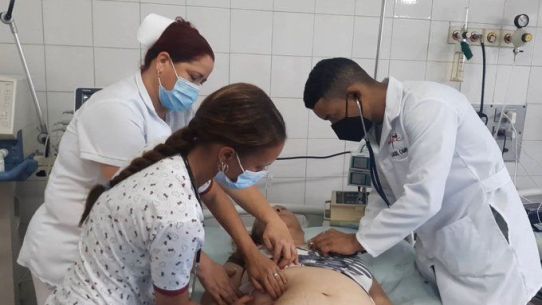
Cuban healthcare workers aided Venezuelan workers and their families before the kidnapping of the Bolivarian leaders in January 2026.
- On January 29, 2026, in violation of the principles of international law and the spirit of the United Nations Charter, President Donald Trump decreed an energy blockade against Cuba and warned that he would impose prohibitive tariffs on any country that fails to comply with his diktat. Since then, the island’s hydrocarbon supplies have been blocked by U.S. armed forces. The pretext cited is that Cuba — a small country of the Global South with few natural resources and under economic embargo for nearly seven decades — poses an “extraordinary threat” to U.S. national security — that is, to the hegemony of the capitalist world system.
The U.S. administration had previously designated Cuba a “State Sponsor of Terrorism,” and on May 20, 2026, the U.S. Department of Justice issued an arrest warrant for former President Raúl Castro, 95 years old, for the “murder of U.S. citizens.” These are two slanderous accusations categorically denied by Havana, which instead denounces recurring U.S.-sponsored terrorist attacks against the island.
By placing Cuba in “Priority 1” (alongside Iran, Russia and China) of the National Intelligence Priorities Framework and reinforcing the CIA’s secret operational unit tasked with handling Cuba, Trump has raised the specter of military conflict. This risk of conflict was made all the more credible by the U.S. Navy’s continued illegal occupation of the Guantánamo base, which Washington refuses to return and whose prison is notorious as a genuine lawless zone. Consequently, Cuba is compelled to mobilize a significant portion of its already severely depleted resources to prepare its defense — doing so under conditions of asymmetry.
- This U.S. blockade aims to inflict maximum suffering on the Cuban population as a whole and to exacerbate discontent and tensions within it — against a backdrop of worsening daily hardships, physical and psychological exhaustion, state budgets stretched to the limit and growing social inequality — with the goal of driving local public opinion to despair and turning it against the revolutionary government.
The blockade’s objective is to shatter the people’s cohesion and dissolve the bonds of mutual aid that unite them by fostering individualism through scarcity and a “fend-for-yourself” mentality; it also seeks — spurred by hateful propaganda orchestrated on social media — to incite street protests and clashes (ideally violent ones), trigger a crackdown by Cuban authorities (also hoped to be violent) and thereby “justify” a U.S. military intervention that could be retroactively dressed up as a “legitimate” operation, even if it lacked legality.
- Furthermore, the international context surrounding this U.S. aggression is deeply concerning. Donald Trump supports the colonialist and segregationist policy against the Palestinian people and the strategy of military expansion against neighboring states (Syria, Lebanon, Iran) being pursued by Israeli Prime Minister Benjamin Netanyahu — [an] alleged war criminal [as charged] by the International Court of Justice for the ongoing genocide in Gaza. Through his European vassals and NATO, Trump is pursuing a proxy war against Russia that his predecessors initiated in Ukraine. He has clearly designated China as the primary enemy to be defeated.
Trump has also stated his intention to seize Greenland and the Panama Canal, deployed the U.S. military outside the Middle East on several occasions (in Nigeria and Pakistan), kidnapped President of Venezuela Nicolás Maduro and confiscated that nation’s wealth, planned the establishment of new military bases in Latin America (in Peru, among other countries), and threatened to invade countries (notably Mexico) and attack heads of state (including former Colombian President Gustavo Petro).
In the United States, the domestic situation is deteriorating — making its ruling classes more dangerous on the international stage. The treatment of migrants — ranging from violence by Immigration and Customs Enforcement (ICE) to the brutal deportation of undocumented individuals — is sowing division across the country.
The resident Cuban community, itself divided, has offered only wavering support to the Republicans in the last three presidential elections. Many Cuban immigrants, including those who arrived legally, are deeply troubled by the administration’s recent hostility toward them. All (or nearly all) have family and friends remaining in Cuba whom they support, to varying degrees, by sending money. None (or almost none) would want to see them perish under bombardment or during a foreign invasion.
The vast majority of Cubans who have recently emigrated to the United States left the island for economic rather than political reasons — economic reasons stemming from the countless daily hardships caused by more than two-thirds of a century of embargo. And for pro-Trump Cubans who have either been deported from the United States themselves or seen loved ones expelled in recent months by the very person in whom they had placed their hopes, the “American Dream” has suddenly turned into a nightmare.
- Thus, oil imports to Cuba were halted starting in January 2026, immediately following the United States’ lightning strike against Venezuela. In December 2025, U.S. armed forces had been ordered to intercept vessels transporting fuel shipments from Venezuela to Cuba. Since September 2025, those same forces had already been tasked with destroying, in the Caribbean Sea, boats suspected of carrying illicit drug shipments bound for the United States. Fueled by the vengeful rage of his Secretary of State, the arch-reactionary Marco Rubio, himself of Cuban descent, D. Trump then stepped up his threats, proclaimed his determination to “take” the island and declared that it was his “next target.”
- The effects of this blockade are extremely harsh. Exploitation of the island’s scarce natural resources (some oil and associated gas) and renewable energy sources covers less than half of domestic needs. Consequently, fuel shortages impact the local infrastructure’s ability to supply electricity in a devastating way. This leads to frequent, prolonged power outages and even nationwide blackouts (seven occurred in the last eight months of 2026). These tough conditions disrupt the distribution of water to the population, food to stores, inputs to research laboratories, medicines and equipment to hospitals, supplies to schools and universities and raw materials and intermediate goods to production facilities.
Every economic sector is seriously affected: banking services, transport, agriculture, tourism, nickel, tobacco and so on. Everything has become far more difficult than in “normal times” — that is, under the embargo alone. While the state possessed the means to capture most of the country’s earnings and thereby safeguard public services during the “Special Period” of the 1990s and 2000s, the economic system now suffers from “leakage”: despite the crisis, the owners of small and medium-sized private enterprises are thriving — most often capitalized by Cubans in the diaspora (including those in the United States, of course) — and are capturing the profits from these new activities.
However, shortages of basic necessities and skyrocketing prices have turned life into purgatory for millions of people. There, as here, the cause of this tragedy is well known: it is the relentless drive for extermination, through a blockade layered on top of the embargo, that successive U.S. leaders have inflicted upon the Cuban people and especially the most vulnerable: children, the elderly, the sick, the disabled, pregnant women … More broadly, the root cause is the dictatorship that the U.S. regime, characterized by a smiling, unashamed fascism, imposes on the entire world, with the culpable, crawling and trembling complicity of Western “elites” in the North and comprador “elites” in the South.
- The quality of Cuba’s universal, free public health system is well-established and globally recognized. Nevertheless, for the past eight months, the harsh U.S. energy blockade has caused healthcare conditions to deteriorate: Energy supplies to non-essential medical services are no longer consistently guaranteed; numerous protocols are interrupted by power outages; and the continuity of life-sustaining care, usually safeguarded by backup generators, is jeopardized during blackouts.
Nearly three-quarters of the nearly 400 domestically produced medicines are out of stock or on the verge of running out, while imports of other pharmaceutical products have stalled or become sporadic. Certain pieces of medical equipment that are out of order often cannot be repaired due to a lack of spare parts. These widespread shortages necessitate the rationing of treatments and, most dramatically, establish priorities in order of importance. Furthermore, the scarcity of transport makes travel extremely difficult for both patients and healthcare workers. Many professionals who chose to remain in Cuba to serve their people report rising mortality rates — a first since 1959 (excluding the COVID-19 pandemic) — as a direct result of the U.S. blockade.
Those specifically affected include premature infants in incubators, newborns requiring surgery, women in labor, mastectomy patients, the elderly on ventilators and patients in intensive care or those suffering from cancer, kidney failure or chronic diseases. Also affected are individuals with initially minor ailments who arrive at the hospital with complications, due to dehydration and/or malnutrition, infections caused by a lack of antibiotics or compromised hygiene standards or delayed care due to unavailable transport.
Currently, more than 100,000 people, including 12,000 children and more than 5,500 cancer patients, have had their surgeries cancelled and indefinitely postponed. It is therefore clear that the U.S. administration has made the decision to condemn an entire people — and, first and foremost, its most vulnerable members — to death. Who, in all conscience, can tolerate such a sentence?
- In May, then in July and again in August 2026, D. Trump issued new executive orders that further tightened the already ruthless trade and financial embargo against Cuba. This resulted in a ban prohibiting companies in a range of strategic sectors (such as energy, mining, metallurgy, construction or financial services) from maintaining any economic ties whatsoever with entities controlled by the Cuban state — particularly those belonging to the Grupo de Administración Empresarial, managed by the Ministry of the Revolutionary Armed Forces and overseeing a large portion of the economy, including the tourism sector.
These ukases [decrees] also affect foreign firms, as U.S. authorities have asserted extraterritorial jurisdiction, meaning the application of U.S. laws beyond national borders. Failure to comply with these decrees would result in the seizure of assets owned by these companies on U.S. soil. Fearing such reprisals, several foreign investors in Cuba, notably in the hotel and cruise industries, have ceased operations on the island. In addition, the U.S. administration announced its intention to take legal action against the leadership of the Instituto Cubano de Amistad con los Pueblos (ICAP, or Cuban Institute of Friendship with the Peoples) due to their “close ideological ties with subversive individuals” within leftist movements in the United States and around the world.
Moreover, on July 29, 2026, a lawsuit based on Title III of the 1996 Helms-Burton Act was filed in the U.S. District Court for the District of Columbia in Washington against the Cuban state-owned company Unión Eléctrica (UNE), which falls under the Ministry of Energy and Mines, and Energas, a joint venture (involving Canadian capital). At a time when the island is being suffocated by a fierce blockade, the plaintiffs in the case, presented as the “legal owners” of the Compañía Cubana de Electricidad, the predecessor to the UNE, are now seeking to collect damages for the “confiscation” of those assets in 1960.
- In mid-February 2026, the first emergency food aid for the island arrived from Mexico. On March 31, a Russian oil tanker, finally breaking the blockade, docked at Matanzas, east of the capital, carrying some 100,000 tons of crude oil (equivalent to 730,000 barrels) in its holds. To date, no other tanker of any nationality has reached Cuba; thus, no other state has yet dared to defy the iniquitous injunction issued by the U.S. government.
Such is the grim reality of the current world order. This order cannot last. It must change. In the meantime, it is stifling Cuba.
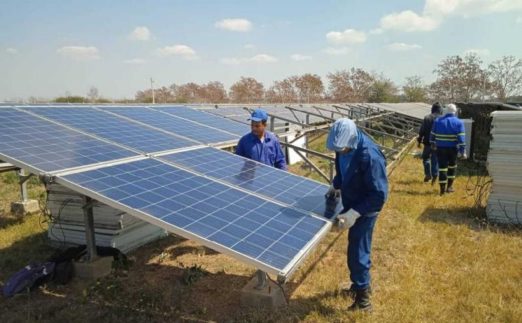
China has been supplying solar panels to Cuba to supply some of the energy the blockade stops. Here, workers are installing the solar panels.
Admittedly, Chinese authorities have delivered tens of thousands of tons of rice and tens of millions of dollars’ worth of electrical equipment (including photovoltaic solar panels) to the island, in keeping with pledges made by President Xi Jinping as early as the end of January 2026. Donations were also sent by, among others, Gustavo Petro’s Colombia. Nonetheless, representatives of U.N. agencies in Havana expressed regret at their inability to distribute emergency humanitarian aid, prevented by the blockade. Besides, in early August 2026, pressure from Washington was still holding up thousands of containers filled with food and medicines in various ports across the Caribbean countries surrounding Cuba.
- Defying the blockade, this oil delivery from Russia on March 31, 2026 — the first (and only) one since the last recorded import from Venezuela on January 9 — elicited nothing more than a curt comment from D. Trump: “No problem!” Yet, he had previously stated that he did not want to see “either Russia or China” on Venezuelan soil, his new zone of maximum influence in Latin America. The United States is now engaged in perpetual military wars in an attempt to prolong the dominance of its giant financial oligopolies, its global control over natural resources and its hegemony over the capitalist world system through the supremacy of the petrodollar (for a while longer).
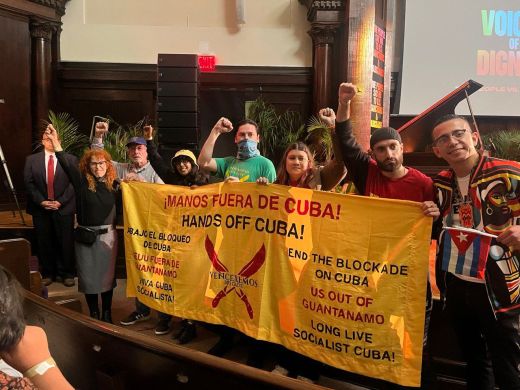
Cuba deserves solidarity from the world’s peoples. Above, meeting in New York City, October 2023.
It is therefore hardly surprising that today, the U.S. is once again attacking the Cuban Revolution and seeking to put an end to the example it represents: an example of dignity, insubordination, courage and resistance. For, unlike monetary reserves or raw materials, the power of ideas is inexhaustible. And the deeply ethical ideas of solidarity and justice that this Revolution has always championed and continues to champion today, with so many honest and generous men and women around the world, are the very ideas that have made humanity truly human. Besieged, tormented and severely weakened, Cuba continues, despite everything, to march alongside history.
- The current energy blockade deprives the Cuban people of resources essential for their survival. It exacts a toll of immeasurable sacrifice, unjustifiable suffering, intolerable hardship. It must end immediately and unconditionally. By undermining an entire population’s rights to food and healthcare — and thus its right to life — the harmful effects of these unilateral coercive measures, which deliberately engineer food insecurity and plan for the shortage of medical care, amount to what some experts have termed a “silent genocide” — one waged without bombs.
Regardless, Cuba’s leaders respond in their characteristic manner, calm yet firm, as they have for decades, combining the defense of national independence and a commitment to the revolutionary process with messages of peace and friendship directed at the people of the United States. While they desire the normalization of relations between the two countries, they maintain that national sovereignty and the conduct of domestic policy (including decisions regarding private-sector participation in the economy) are non-negotiable — even as the U.S. administration pushes for the return of neocolonial capitalism to the island.
The choices made by the Cuban people, who assert their right to development and embrace socialism, must be respected. It is not socialism that should be blamed for the problems Cuba faces but rather the undeclared war waged against it by imperialism. The island pays a heavy price for standing up to that superpower. Like the embargo it compounds, the energy blockade is not only cruel and criminal but inhumane.
Faced with this collective punishment, the Cuban people continue to act, as best they can and in the way they know how, through solidarity: both internally, by sharing the little they have, and externally, as illustrated by the internationalist medical missions recently sent to Venezuela (following last June’s earthquakes) and Mozambique, among others.
The collective resistance of [the Cuban] people is heroic. At this moment, Cuba is buckling under deprivation and suffering, yet it does not break. It does not surrender. As for us, we owe [Cuba] active and urgent solidarity. Building a different world order is a duty.


You must be logged in to post a comment.