
Amílcar Cabral, founding of the PAIGC and the liberation of Guinea-Bissau
By Carlos Lopes Pereira
September 25, 2026
Carlos Lopes Pereira, a former member of the Secretariat of the African Party for the Independence of Guinea-Bissau and Cabo Verde (PAIGC), writes about African events for Avante!, the newspaper of the Portuguese Communist Party. This article was published Sept, 24, 2025, in Avante! Translation: John Catalinotto
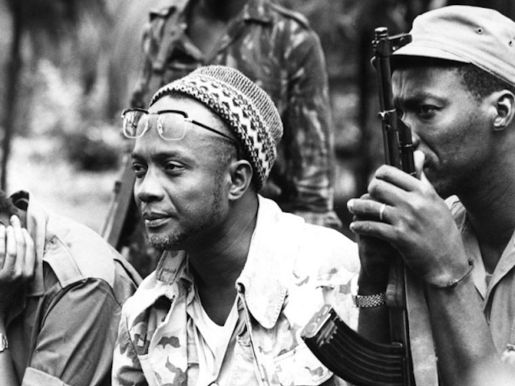
Amílcar Cabral, leading African Marxist and leader of the liberation struggle in Guinea-Bissau and Cabo Verde, born Sept. 12, 1924, shown here with fighters of the guerrilla movement.
In September the people of Guinea-Bissau mark three significant dates in their country’s contemporary history: Sept. 12, the anniversary of Amílcar Cabral’s birth (in 1924, in Bafatá) [Cabral was assassinated in 1973]; Sept. 19, the anniversary of the founding of the PAIGC (70 years ago, in Bissau); and Sept. 24, the anniversary of the proclamation of the Republic of Guinea-Bissau (in 1973, exactly 53 years ago, in the liberated areas of Boé).
To honor Amílcar Cabral today is to revisit his example as a revolutionary of integrity, his work, his theoretical legacy, his international prestige and his immeasurable contribution to the liberation of the Guinean and Cabo Verdean peoples — who consider him their national hero — and to the common struggle of the peoples under Portuguese colonial rule, as well as to the liberation movement of the African peoples.
Having lived in Portugal from 1945 to 1960, where he studied and worked — he graduated with honors as an agricultural engineer from the Instituto Superior de Agronomia in Lisbon — he actively participated during that period in the struggles of Portuguese anti-fascists against the dictatorship led by António de Oliveira Salazar, within the framework of the Youth Democratic Unity Movement and on other fronts.
At the same time, at the Casa dos Estudantes do Império [House of the Students of the Empire], where he served as vice president, he rubbed shoulders with young Africans studying in the colonial metropolis — future leaders of the liberation movements — such as the Angolans Agostinho Neto, Mário de Andrade and Lúcio Lara, the Mozambicans Marcelino dos Santos and Noémia de Sousa, the São Toméans Francisco Tenreiro and Alda Espírito Santo and the Guinean Vasco Cabral, among others.
Seven decades of PAIGC
From the early 1960s onward, Amílcar Cabral devoted himself entirely to the national liberation struggle of the peoples of Guinea and Cabo Verde. Earlier, in late 1956, along with other Guinean and Cabo Verdean patriots, he had secretly founded in Bissau the African Independence Party (PAI). This party later adopted the name, African Party for the Independence of Guinea and Cabo Verde (PAIGC) — the great popular force that organized, led and won the struggle for emancipation against colonial rule and which this September celebrates seven decades of existence.
Early in the 1960s, on at least two occasions, Amílcar Cabral proposed negotiations to the Portuguese fascist regime aimed at a peaceful resolution of the colonial issue, with recognition of the right to independence for Guinea and Cabo Verde.
The fascist and colonial Salazarist dictatorship, confident in the political, economic and military support of NATO countries and the apartheid regimes of southern Africa, did not even respond. Instead, it opted for war — in Angola (beginning in 1961), in Guinea-Bissau (since 1963) and in Mozambique (since 1964). This war, which lasted more than a decade, caused thousands of deaths and injuries and only ended after the April Revolution [in Portugal] and with the recognition of the Republic of Guinea-Bissau in 1974, followed by the independence of Cabo Verde, São Tomé and Príncipe, Mozambique and Angola throughout 1975.
Regarding the relations between the new African nations and Portugal, Amílcar Cabral reiterated in 1972, looking ahead to the future: “(…) We are not against the Portuguese people, and we do not fight — nor will we ever fight — the Portuguese people. We are, however, against colonial domination, and we are fighting the colonial system. But we truly hope that after our independence, our liberation, we can have good relations with Portugal and the Portuguese people and work side by side for democracy, peace and progress.”


You must be logged in to post a comment.