
The collapse of the political center – a view from the EU
By Manuel Raposo
October 2, 2026
The author is a Portuguese Marxist and editor of the web magazine jornalmudardevida.net, where this article was published in Portuguese on Sept. 28. Translation: John Catalinotto
The Alternative for Germany’s (AfD’s) two decisive victories in Germany’s recent regional elections signal a shift in the political landscape, not only in Germany but also in Europe. The possibility that Marine Le Pen [National Rally, formerly National Front] could win the presidential election in France next year and that Nigel Farage could overtake the Labor and Conservative parties in Britain reinforces this trend.
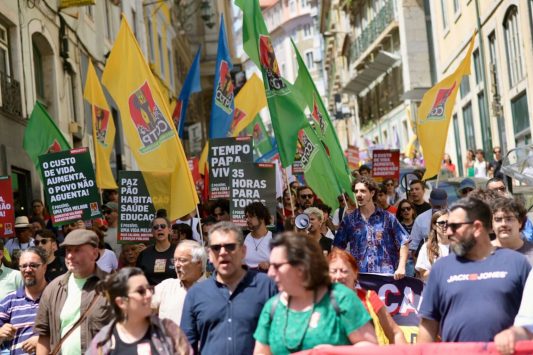
When workers took to the streets in Lisbon, June 3, 2026, to demand 35 hour week, and peace, bread, health care and education, they stopped the anti-worker “labor reform package.”
Should this happen, the only new development will be that these are the three major European powers, since signs of the rise of the far right have already become evident in Italy, Austria, the Netherlands, Sweden and Finland — not to mention Portugal.
The political forces that for decades constituted a hegemonic center — typically consisting of two parties that alternated in government with virtually identical policies — are at risk of being pushed out of power. They show no ability to resist the offensive or to regain the support that once made them dominant. What is happening is not a mere electoral accident; it is the dismantling of a political order — even if events do not follow a straight line or take the exact same course in every country.
This shift is breaking up the Christian Democratic Union (CDU) / Social Democratic Party of Germany (SPD) duo in Germany; it threatens the Labor-Conservative pairing in the United Kingdom; it has dismantled the Socialist-Center-Right (Gaullist or otherwise) alternation in France; and here in Portugal, it has upended the two-party system between the Socialist Party (PS) and the [rightist] Social Democratic Party (PSD).
In the U.S., the Republican-Democratic tandem remains as it was only in name: the Republican Party, hijacked from within, is now the bastion of the far right and serves as a beacon for the new international fascism. Even in countries that lack decisive political clout (the Netherlands, Austria and Belgium, for example), party fragmentation and the difficulty in forming stable governments are the dominant political themes.
At least in Europe, what explains the collapse of these centrist parties is the fact that the “sociological” base on which their policies rested — the middle-class bloc — is disintegrating. Specifically, considerable segments of the middle and petty bourgeoisie, as well as the working classes, no longer feel represented by these parties and are being drawn to the far right’s promises of “change.” Why this is happening is a key question for understanding the current political landscape and what the near future holds.
What conditions allow the political center to persist
The way in which this political center was formed and the conditions under which it persisted for decades provide clues to understanding why it is now disintegrating.
This situation is characteristic of countries with developed capitalism — whether imperialist or within the orbit of imperialism. Indeed, only in those kinds of countries did relative but sustained economic prosperity provide those social strata — the middle-class bloc — with a stable outlook on life. And it allowed the centrist parties — the unchallenged political managers of capitalist interests — to present themselves as the guarantors of that stability.
From the end of World War II until the late 1960s, capitalism in these countries was able to maintain a social pact — whether formal or tacit — that provided regular wage increases, social support systems and public services unparalleled in the rest of the world, the so-called “underdeveloped” world — from which, incidentally, the extra profits that made the bulk of these benefits possible originated. Through these means, developed capitalism bought the peace and political support of the middle classes and a large portion of the working classes.
The decline of imperialist capitalist economies, evident since the 1970s, marked the beginning of a reversal of the so-called social pact. This decline — characterized, in politics and economic policy, by so-called neoliberalism, which began its pioneering experiment in Pinochet’s Chile in 1973 and took root in Britain and the United States [in the 1980s] under Margaret Thatcher and Ronald Reagan — was offset by the capitalist expansion of the 1980s and 1990s, as a result of China’s opening to Western capital and the demise of the Soviet Union and Eastern Europe.
This new phase, however, was short-lived: the economic and financial crisis of 2008–2009 sounded the death knell for the globalization of imperialist capital and the neoliberal path that accompanied it.
The end of an era
“We cannot live beyond our means” was the statement that marked the new era and what was to come. Triumphant capitalism confessed to the failure of an entire economic, social and institutional system.
Viewed in its fundamental aspects, the crisis that began nearly twenty years ago provides us with an X-ray of the terminal state to which bourgeois civilization has arrived. The world is witnessing the collapse of the capitalist system of production, which has entered a state of permanent stagnation with no prospect of recovery. Consequently, the entire edifice built upon it is now in question.
The growing difficulty in reproducing capital translates, in effect, into an equal difficulty in reproducing social relations. Hence the decomposition of institutions, the hollowing out of democracy, the abandonment of the banner of progress and the erasure of the great bourgeois beliefs (nation, homeland, family — which the far right is reclaiming).
The ideology of continuous progress and prosperity — which has always been the hallmark of bourgeois positivism and the assertion of capitalism’s superiority over backward social formations — has been transformed into a discourse justifying regression: no longer is employment guaranteed, no longer are living standards improved from one generation to the next, no longer is consumption and leisure time increased, no longer are health care and education promised for all, no longer is social protection offered.
This new discourse exposes the ruling classes’ inability to convince the ruled classes that the capitalist system of social organization is superior; it exposes a civilization’s inability to mobilize the whole of society around its class objectives. A society that now guarantees — in the very words of its own leaders — a tomorrow worse than today and which claims it can only survive under these conditions is a society heading toward its end.
The defection
The continuous decline in living conditions and the resulting growing social disorganization strike the working classes first and then the lower middle classes, gradually spreading upward through the middle strata. It is in this fertile ground that the new far right spreads and grows.
The segment of the population upon which social peace was built during the “good old days” has been penalized for nearly 50 years in the areas that hurt them most: their daily lives and their children’s future. For this very reason, these people ask what reasons they have left to continue believing the centrist parties are doing good work, when those parties prove incapable of addressing growing poverty, the general decline in living standards and the resulting social chaos.
Beginning in 2008, the ruling bourgeoisie openly decreed the dismantling of the social pact. In response, the middle and petty bourgeoisie and the upper sectors of the working class that had supported the center responded by defecting. Shifts in voter behavior are practical proof of this defection.
A change in leadership
Thus, the likelihood of a change in leadership in the major European countries is growing. This change has already occurred in the U.S.
The struggle is particularly acute within the European Union (EU). The political elite based in Brussels, Strasbourg or Frankfurt — along with NATO’s military network — are resisting by every means possible the forces that challenge their authority or simply pose political obstacles to their rule.
There is no shortage of examples: The annulment in 2024 of the Romanian elections won by Calin Georgescu, who condemned European support for Ukraine against Russia. The campaign to defeat Viktor Orbán in Hungary, for the same reasons. The assassination attempt on Slovak Prime Minister Robert Fico, again for the same reasons.
The accusations that the Russian government funds and supports far-right forces (while Trump’s fascist gang does so openly and with impunity). The recent threats by the German government, trying to declare AfD unconstitutional. Anyone who dares to oppose the EU’s war-mongering stance and its policy of cutting ties with Russia, which has disastrous economic consequences, is called treasonous.
But big capital — fundamentally the dominant monopoly financial capital — does not reject the far right. On the contrary, it welcomes its rise to the extent that it can use it to strengthen its iron grip on the various social strata, now in disarray.
It seems to want merely to purge the far right of unstable (and therefore dangerous) elements and above all to test the ability of newly arrived leaders to take the reins of governance smoothly, without disruptions that would affect the stability of power and the continuity of business as usual.
The far right itself acts contrary to what it proclaims, in that it comes to the aid of established regimes, seeking to rally the masses under new banners, that is, the section of the masses who have slipped beyond the control of the worn out parties of the center.
The far right has no choice but to point out, in a measured and timely manner, the palpable ills of the regime. This is the condition for attracting the attention of the discontented masses. But its ultimate function, which is the same as that of classical fascism, is to lead the disaffected social strata back into the old capitalist-bourgeois fold. The image of a “new” leadership and “new” parties masks the permanence of the underlying regime.
An easy success, because it is facilitated
The main forces of the far right draw to themselves all the fascist-Nazi scum and the most diverse reactionary strata. But their electoral successes cannot be attributed to these sectors or to the foul ideological arsenal they carry. This applies to the narrow electoral base these strata constitute but not to the evident fact that such organizations have rapidly become mass parties.
Far-right propaganda attracts the support and votes of the working classes, particularly workers and the poor — even drawing into the political fray groups that normally abstain from voting, as has been seen here in Portugal and now in Germany as well. It achieves this, because it touches on issues that are immediately sensitive to the masses: living conditions, a bleak future, cronyism and corruption in the political system and competition among workers, which is exacerbated by immigration.
But the reasons for the far right’s easy growth, so far, are not limited to the collapse of the bourgeois center (due to the causes mentioned above). Another reason — a decisive one, in fact — lies in the absence of a radical left with critical clout that plays the role it should: tackling the immediate problems of the masses at their root by linking them to the decay of the economic, social and political system.
Ultimately, therefore, the far right has been able to grow unchecked partly because the field is wide open — since no socialist-communist left party with an openly anti-capitalist voice has yet to emerge.
The growth of fascist forces can be stopped. In those instances — still rare — where a call for mass resistance has emerged, the far right and the right have been halted or suffered setbacks. This occurred recently with Die Linke’s electoral victory in Berlin; it is happening with LFI [La France Insoumise, founded by Jean-Luc Mélenchon in 2016] in France which has mobilized against the fascist right; and it took place in the New York mayoral race involving Zohran Mamdani — a Muslim and a “socialist” — who defeated the old Republican and Democratic establishment.
Even more significant were the two general strikes held in Portugal, last December and June. These demonstrated that victories — at least partial ones — can be achieved when class consciousness shapes the goal of the struggle. The workers’ response, in which street protests played the leading role, was decisive in preventing the right, the far right, the government and the business establishment — collectively identified as a single target — from passing the terrorist-like amendments to labor legislation.
A political path yet to be established
The accusations of “populism” with which the dominant political forces attempt to characterize the far right are a diversion: on the one hand, they mask the fascist nature of these movements, leaving the door open for compromises with them when necessary (“we are all equally elected democrats”); on the other hand, they dismiss as demagoguery the real problems of the masses that the far right highlights in its quest for support.
Fascist demagoguery lies elsewhere. It lies in its pretense of addressing the critical problems of present societies while obscuring their root causes:
– first, the senile bankruptcy of imperialist capitalism — to which the far right is umbilically linked — whose crisis is structural, permanent and universal in nature rather than merely cyclical or regional;
– second, the decay of the respective social systems, of which the far right is a part and of which it is a byproduct, the extreme dregs.
Thus, neither the “nationalist” palliatives nor the critical verbiage the far right displays will be able to respond to the catastrophe.
Effective solutions can only come from outside: from a mass anti-capitalist opposition — which the far right, by its very nature, cannot provide — and from a socialist-communist political path, which the right and the far right evidently abhor. Only this contrast — drawing a clear line between the working classes and both the far right and the right — can reveal to the working classes the dividing line between a future shaped by their own initiative and the quagmire in which they are being held.
Given the difficulty of the current situation, this is the path by which workers can gradually move from the defensive — where they have exhausted their strength parrying blow after blow — to an offensive stance that opens up new horizons for them, commensurate with the social and political changes currently taking place.


You must be logged in to post a comment.