
Trump’s trade war against Canada
By G. Dunkel
October 2, 2026
President Trump heartily approves of tariffs. He pretends that they are not taxes, even though they are essentially a sales tax on imports from a country, paid by the company or individuals that receive them, and usually passed on to consumers.
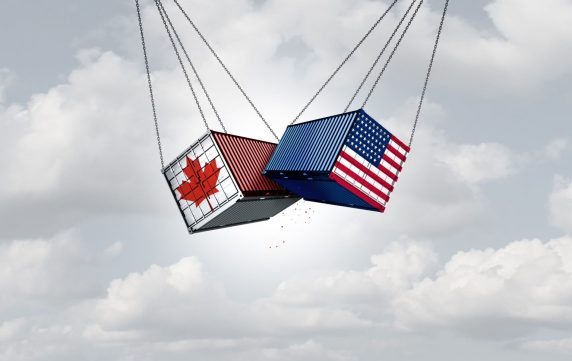
On April 2, 2025 — so called “Liberation Day” — Trump imposed tariffs — ranging from 10 to 48 percent — on imports from virtually every one of the United States’ trading partners. He wanted to limit access to one of the biggest and wealthiest markets in the world to increase domestic industrial production and employment.
It didn’t work.
The Supreme Court declared most of Trump’s tariffs illegal, although he found various subterfuges to reinstate them. But economic indicators, such as construction projects for new factories, indicate that these tariffs did little to reindustrialize the U.S.
Most countries didn’t reject Trump’s tariffs, but Canada did. Its economy is tied to the U.S., which is Canada’s largest export market. The U.S. gets more than two-thirds of all Canadian merchandise exports. U.S. imports from Canada amount to about 3% of all U.S. imports.
In August 2026, Canada imposed tariffs that matched Washington’s dollar for dollar and rate for rate on about $20 billion worth of imports.
Canada’s Prime Minister Mark Carney began an effort to sharply reduce Canada’s dependence on the U.S., which has led to bombastic threats and outrageously insulting propaganda from Trump. Carney is actively traveling the world to find new trading partners.
Carney is currently considering major changes to Canada’s military purchases. In 2023, Canada placed an order for F-35 fighter jets with Lockheed Martin that is under review. The initial deliveries are slated for 2026. To date, 16 planes have been paid for and an additional 72 are under consideration. The total cost is around $19 billion Canadian (CAD) (approximately $13.43 billion USD).
As for Elon Musk’s Starlink service, Carney has voiced concerns that relying on a foreign, Trump-ally-controlled network for critical defense and communications infrastructure poses risks to Canadian sovereignty. The alternatives are less powerful but more secure.
Canada is seeking “associate membership” in the European Union. Exactly what being an “associate member” involves is not clear, but what this move shows is that Canada does have trading options other than the U.S.
Trump’s reaction to Canada’s response
Trump has increased his propaganda campaign against Canada — both in silly insults, like calling Prime Minister Mark Carney “Governor” Carney, pretending Canada is the 51st state of the union, and serious moves, like banning some Canadian dairy products, motorcycles and most alcoholic beverages.
In an offensive jibe, he renamed Lake Ontario “Lake America.”
He told the U.S. General Services Administration to declare Canadian products ineligible for large, long-term federal contracts.
Earlier he predicted Canada would collapse under the weight of the U.S. bans and tariffs, which wouldn’t apply if it became the 51st state.
Before Trump, the relations between Canada and the U.S. were extremely close. Around 400,000 people a day crossed the border, for all sorts of reasons, even to see a movie, get lunch or use a laundromat. Firefighting companies had joint help agreements; on a state-to-state level, defense and security arrangements were close and active. According to data from the Canadian government, the total number of Canadians returning from the U.S. has dropped by 25% over last year.
Could Canada actually win this trade war?
Canada is an imperialist country that hugely benefits from exploiting countries in the Global South; 75% of the major mining companies in the world have their headquarters in Canada. If the big Canadian bourgeoisie believe that their profit streams from the mines are threatened by this trade war, they are likely to make a deal to end it in ways that favor the continued domination of the United States.
Government of Canada statistics show that almost half of the minerals exported through Canada in 2020, about $90.2 billion, were mined outside the country. Canadian companies spend about 14% of all the money expended worldwide on prospecting for minerals.
Besides its deep interests in mining, Canadian troops also fought alongside U.S. troops in Korea, Afghanistan and the first Gulf War (1990-91).
Trump’s propaganda has had the effect of solidifying public opinion behind Carney. The Canadian people want to keep their readily available healthcare, their enforceable labor laws, their culture and the recognition of the rights of the Quebecois to preserve their particular culture.
Polling data shows that a substantial proportion of U.S. residents support Canada in this dispute, while U.S. public opinion reflects the fact that Trump’s tariffs are raising prices at home while making some goods unattainable.
Beyond the political issues involved in this trade war, the fact that the U.S. economy is at least 10 times larger than Canada’s generally would mean the U.S. would win an economic conflict. But U.S. refineries rely on 4 million barrels of oil a day from Canada, U.S. farmers depend heavily on Canadian potash fertilizer, and much of the electricity consumed in New England comes from Newfoundland and Labrador, a Canadian province.
Industry Minister Mélanie Joly put the government’s ambition plainly: “I’m convinced that we will be able to show the world that Canada will win this trade war.” (apnews.com, Sept. 8, )


You must be logged in to post a comment.