

By G. Dunkel
October 9, 2026
“To confront repression, class unity” was written on the banner that some high school students carried in a Paris demonstration the first week of October.

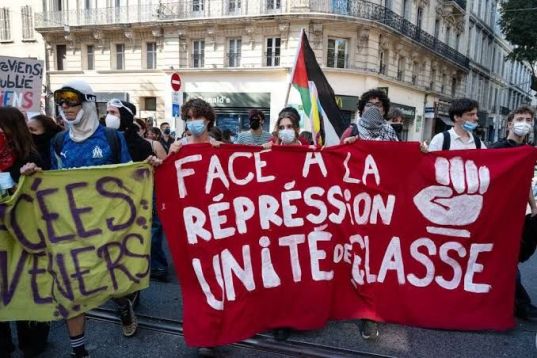
Student demonstration, Paris, Oct 6. The banner says: “Confront repression with class unity”.
What is happening in France today is developing the class unity that workers in France must build to defeat the harsh austerity measures that the current government of President Emmanuel Macron is imposing. This unity is needed to repel the neofascist regime that the far right intends to install if it wins the presidential elections in 2027.
On Sept. 21, the students at a high school in Créteil, a city in Val-de-Marne southwest of Paris, began a protest over conditions in their school — absence of teachers, particularly reliable substitute teachers; dilapidation of their buildings; windows that couldn’t be opened and overcrowded classes with 35 students in them. They were also protesting Parcoursup (France’s pre-enrollment platform for first-year higher education) and the government’s proposed austerity budget.
According to a French government survey, 70 % of high school classes had 30 students in them; 20% had 35. The average school building is over 60 years old.
Education in France is predominantly directed nationally. But students made it clear that they believe state investments are especially scanty in working-class communities.
Within a few days of the first walkout, high school students in the Paris suburbs, which are mainly working-class and poor, were protesting and demonstrating; there were blockades in many of them, enforcing a student stay away. By the beginning of October, protests had spread throughout France and expanded to universities.
This mobilization of teenagers and youth was totally unexpected and was met with a harsh and violent police response. According to Prime Minister Sébastien Lecornu, 225 students and 70 cops have been injured. Over 6,000 people were arrested. (cnn.com, Oct. 6)
Solidarity with the students
Militant labor unions, including the oldest union in France, the General Union of Labor (CGT), and unions of parent associations came out to student-called demonstrations. They stood between the cops and the students in the hope of keeping their children safe from police violence.
Bally Bagayoko, the mayor of Saint-Denis — a working-class city of 125,000 north of Paris — stood between the cops and protesters. He was roughed up, but the cops had to back off. Bagayoko’s confrontation was caught on videotape and played on the state-owned broadcasting system TV2. He is the son of Malian parents and a member of La France Insoumise (LFI) (France unbowed), a left-wing Marxist party.
So much attention was focused on the vile and violent actions of the cops that when a plainclothes cop was caught on video molesting a young female protester, which was quickly spread on social media, TV2 had to show the video clip to preserve its aura of objectivity.
CGT General Secretary Sophie Binet, in an interview with TV2, made it clear that while the CGT wanted to help protect the students, it was not directing their efforts. As she said, “Student protests are being run by students.” (Oct. 6)
National demonstrations that the student unions called for Oct. 6 occurred in 40 localities and drew large turnouts in all of France’s major cities — Caen, Lyons, Marseilles, Nantes and Paris. Alongside high school and university students, the marches contained contingents from labor unions and left-wing parties, as well as parent associations.
The CGT claimed over 400,000 attended the demonstrations; the cops said they drew 225,000 people.
While the whole thrust of these demonstrations was domestic policies, signs and T-shirts also called for a “Free Palestine,” condemned France’s inaction over the genocide in Gaza and raised ecological concerns.


