
From Madrid to Paris and Brussels: The youth won’t take it any more
By Marc Vandepitte
October 16, 2026
The author is a Belgian economist and political analyst, who wrote the article for the newspaper dewereldmorgen.be, published Oct. 12, and produced a Spanish version that was published Oct. 14, rebelion.org . Translated from Spanish by John Catalinotto.
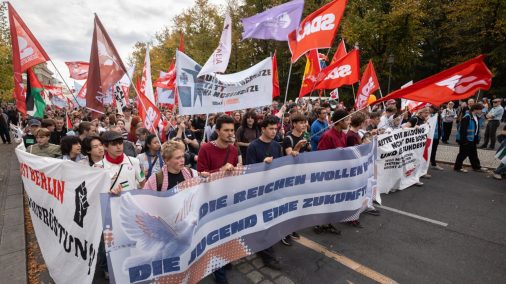
In Germany, high-school students protest the threat to reintroduce conscription.
While governments allocate billions to military spending, young people are told there is no money for education, affordable housing, or stopping climate change. From Brussels to Madrid, they are no longer willing to put up with these policies and are questioning the very foundations of our society.
A specter is haunting the world — a specter that has already brought down several governments and is driven by so-called Generation Z, that is, young people born between 1997 and 2012.
Young people are putting elites around the world on the spot. In a short time, they caused the governments of Bangladesh, Nepal, and Madagascar to fall. Meanwhile, massive youth protests continued to grow in Morocco, Indonesia, the Philippines, Kenya and Peru.
In Europe, too, young people are taking to the streets en masse. They are filling streets, squares, and universities in Spain, Germany, France, Belgium, the Netherlands, and Italy. They are organizing demonstrations, occupations, solidarity actions and student protests.
The reasons vary from country to country. Sometimes the issue is Palestine; other times it is education, climate change, racism, budget cuts, unaffordable housing, the rising cost of living or corruption scandals. But behind these separate demands, the same question is increasingly emerging: What kind of society do we want to live in?
Jordan Devlin, arrested following an act of direct action against the Israeli arms manufacturer Elbit Systems in Great Britain, said: “I am taking action against Elbit because the risk of spending months in prison pales in comparison to the despair one feels upon witnessing the horrors they facilitate. In this case, the distinction between right and wrong is clear cut, with no gray areas, which is why I feel honored to seize this opportunity to help build a world in which I want to live and to completely eradicate the obvious evils of this society that we have all been lulled into ignoring.”
During the Oct. 5 high school student protests, Mohammed Boufous, a senior at the Athénée Charles Janssens in Brussels, expressed the frustration shared by many young people: “We are young students. We have come to demonstrate peacefully to convey our message. All we ask is that you listen to us. We want you to stop making decisions about us without consulting us.” (bx1.be, Oct. 16)
In recent years, resistance has been nowhere more visible than during the massive solidarity with Palestine. Young people who had previously been barely politically active took to the streets. They organized actions at universities, set up tent camps, and demanded that institutions sever their ties with Israeli companies and universities.
They did so despite often finding themselves in a hostile environment. Students were accused of extremism, university authorities sent police onto campuses, and political leaders tried to limit the protests or discredit them.

High-school youths in France fight for better schools and spark broad rebellion.
Clashes with police also occurred in France and Belgium during the recent high school student protests. Salomé, one of the French students who participated in the blockade of a high school, said: “The blockade was going peacefully. Then the riot police arrived at full speed. They started running towards us and spraying everyone with tear gas. They were chasing us as if they were enjoying it.” (Le Monde, Oct. 6)
Lola, 16, also from France, was not intimidated by the police action on October 2. “That just makes us even angrier,” she said. “The police have no right to hit us or use tear gas against us.” (rtve.es, Oct. 6) In France, a 15-year-old high school student lost a hand when a police grenade exploded.
In Liège, Belgium, the situation also spiraled out of control Oct. 8. An anonymous student recounted how he was injured during a demonstration: “We were taking part in a peaceful, fully authorized demonstration against the reforms. We were on Boulevard d’Avroy, behind the fairgrounds, when I was shot in the neck with an air rifle.” (Lavenir.net, Oct. 8)
Despite this police violence, young people continue to take to the streets. This generation is discovering that politics is much more than just checking a box on a ballot once every few years. Politics also means coming together, organizing, applying pressure, and refusing to accept what is presented as inevitable.
An apathetic generation?
Young people are often described as individualistic, addicted to social media, or politically apathetic. That image is becoming less and less accurate. Through youth protests, on the contrary, we see a generation deeply concerned about the world around them. This generation talks about war and climate change, but also about rent prices, precarious employment contracts, psychological pressure, discrimination, and the commodification of education.
Many young people are growing up amid constant uncertainty. Owning a home is becoming out of reach for many. Education is getting more and more expensive. Stable jobs are becoming increasingly rare. Public services are under pressure. At the same time, they see billions being spent on weapons, while governments claim there isn’t enough money for social protection, culture, or education.
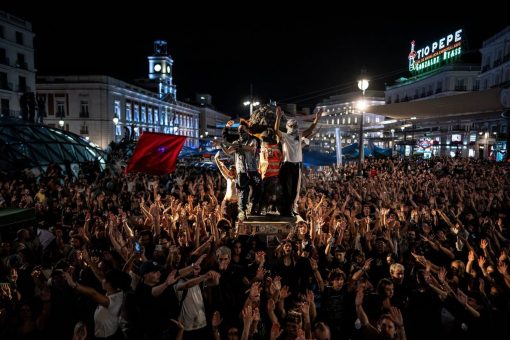
La Puerta del Sol, Madrid, Spain. Hundreds of thousands of people across Spain fight for decent housing.
The magnitude of this uncertainty is reflected in the recent housing protests in Spain. Victoria Nájera, a 27-year-old resident of Madrid, has been living on her own for a few months, but she spends more than 40% of her salary on rent. The lack of prospects amid the housing crisis often brings her to tears at home. “I don’t see a future where I can own my own home,” she said Oct. 3. (elpais.com, Oct. 3)
And it’s not just young people who are suffering from this situation. In Las Palmas, Aisha, 36, protested alongside her four-year-old daughter. Both she and her partner work, but even with two incomes, they barely manage to make ends meet. “We pay 1,000 euros in rent, and often we can’t make it to the end of the month,” she said.
Young people are told they’ll have to make sacrifices. But more and more of them are asking a simple question: Sacrifices for what, and for whom?
Added to this is the climate crisis. Young people feel heat waves becoming hotter, floods destroying entire towns and wildfires reducing vast areas to ashes. For them, these are no longer distant threats, but warnings about their own future, which is becoming increasingly precarious. As the need for drastic measures grows, all they see in political leaders is procrastination and a lack of initiative.
War looms. European governments are drastically increasing their military budgets, and more and more voices are calling for mandatory military service. In France, the Chief of Staff of the Armed Forces said that the country “must be prepared to lose [sacrifice] its children.” (radiofrance.fr, Nov. 25, 2025) But for this generation, that is unacceptable: as the German student strikes demonstrate, young people refuse to serve as cannon fodder for decisions they never made.
Political awareness
What makes these protests intriguing is that the various demands are increasingly interconnected. Those protesting the war in Gaza also speak out against colonialism and racism. Those taking to the streets for climate justice are speaking out against corporations that reap profits while they shift the social costs onto the public.
Students protesting rising tuition fees are drawing a connection to cuts in public services. Young workers mobilizing for better wages are confronting the same economic logic that is also putting pressure on housing, healthcare, and transportation.
That doesn’t mean all young people share the same analysis. Nor does it mean there is a single, large, cohesive movement. But there is a growing awareness that the problems people face are not entirely separate from one another.
Discrimination is not just an individual problem when entire groups are systematically denied opportunities. Poverty is not a personal failure when wages fail to keep pace with housing and living costs. The climate crisis cannot be solved by telling people to use different straws or shopping bags, while large corporations continue to increase their production and emissions.
And it is difficult to credibly advocate for peace when governments are simultaneously investing record amounts in weapons. Political awareness grows through these kinds of connections.
Fundamental questions
The way many young activists speak is also striking. Their message is often less based on slogans than their opponents would have us believe. Anyone who listens to interviews with students, climate activists, or young union activists usually does not hear empty slogans. They calmly explain why they are protesting.
They speak of family members in Gaza, of fellow students who can no longer afford their education, of friends who cannot find housing, of the fear of climate change, and of the racism they personally experience or witness. Their tone is sober, but their demands are no less fundamental for that — quite the opposite.
They are not content with minor adjustments to existing policies; rather, they raise questions about how power and wealth are distributed. Why do shareholders have more influence than workers? Why are multinational corporations able to reap ever-greater profits while governments impose budget cuts? Why do homeless people have virtually no protection, while real estate has become an investment commodity?
Why is military violence so quickly presented as a solution, while diplomacy and social investments are constantly dismissed as naive or too expensive? Why does the West talk so much about democracy and human rights while continuing to unconditionally support Israel? Why do governments continue to grant billions in subsidies to fossil fuels while the climate crisis grows ever more severe?
These questions do not concern marginal phenomena; rather, they touch on the very foundations of how our society is organized.
Together we are strong
In the past, social progress never came about on its own. Labor rights, women’s rights, the right to vote, anti-racist legislation, and social security were won because people organized. They simply refused to believe that the existing order was immutable and demanded their rights.
Today, too, change often begins on a small scale. College students rebel against their university administrations, high school students organize climate strikes, and young people join a union. Committees in solidarity with Palestine and neighbors protesting unaffordable housing also demonstrate this same desire for change.
These separate initiatives sometimes seem vulnerable, but when different movements come together, their impact grows. Thus, a student protest becomes part of a broader struggle for public services. Climate action intersects with social justice, while anti-racist organizations, unions, feminist movements, and peace activists reinforce one another.
Therein lies the true strength of this generation, and this can serve as an example for older generations. An important question in this regard is how much space they are given to shape their own future and to what extent they can count on the support of teachers, workers, and other sectors of the population.
Those who refuse to remain silent can bring about significant change — which is especially true when young people realize they are not alone.
Note: The term “Generation Z” stems from a tradition in which marketing specialists divide the population into target groups (consumers) with supposedly common characteristics. But young people themselves do not form a homogeneous group. What drives them to take to the streets today cannot be explained simply by their year of birth. Their protests are, above all, a reaction to the social conditions in which they are growing up and to the uncertainty about their future.


You must be logged in to post a comment.