

By John Catalinotto
October 29, 2026
For the second weekend in a row, more than a million demonstrators in hundreds of European cities defied threats of repression to march and present their demands to the governments. The people want more funds for education and healthcare, higher wages for workers, affordable housing and a lower cost of living.
Mass, militant actions took place in France, Italy, Belgium, Spain and other European imperialist countries. Also in Eastern Europe.
The central action, however, remained in France, where organizers report that 800,000 people defied the government’s decision to send 70,000 cops and gendarmes (national police) to threaten violence. High school and university students, their parents, the organized working class and the Yellow Vests joined in to fight for their demands and prepare for future actions.


Strasbourg, France, Oct. 24, 2026. Part of 289 actions throughout the country: ‘Liberty, equality, dignity.’
The French ruling class, its national government under the well-despised President Emmanuel Macron and the regimes and corporate media throughout Europe had waged a propaganda war all week attempting to paint the demonstrators as “violent” and “vandals.”
This violence-baiting tactic aimed to create a pretext for increased repression. It was also an attempt to break up the current unity of students, union workers and the Yellow Vest movement (who represent the impoverished rural and small town middle class) and frighten them from coming out in the streets. It failed.
Even before the Oct. 17 demonstrations, French riot cops had arrested 7,000 people, mostly the high school students who initiated the actions. Thousands were arrested that day and another 1,314 on Oct. 24, according to the Interior Ministry. Brutal police actions had cost the eyes of some of the youth and the hands of two. Despite this brutality, people joined marches in 289 different cities and towns throughout France.
Perhaps the protesters believed that a regime that supports Israel’s genocide against Palestinians, cooperates with the U.S. war against Iran and funds NATO’s proxy war in Ukraine — all the while brutalizing its own youths — has no business accusing anyone else of “violence.” (Who are the perpetrators?)
Organizers said that 250,000 people marched and demonstrated in Paris alone. Mass demonstrations filled the plazas in the larger cities and clashed with riot police in some. French media report that police used tear gas against the people in Lyon, Clermont-Ferrand, Strasbourg and Bordeaux and water cannons in Nice and Nantes.
A popular chant of the protesters was “Resign! Macron; Le Pen, prison!” The latter refers to Marine Le Pen, the pro-fascist politician found guilty last July of embezzling European Union funds. Le Pen has promoted her National Rally party for next year’s election, claiming this party is best suited for keeping order, that is, at wielding repression.
General strike Nov. 5
One of the major union confederations, the General Confederation of Workers (CGT), has called for a general strike on Nov. 5. If the unions’ alliance in action with the youthful protesters and the Yellow Vests continues, a general strike takes the struggle a notch higher, since withholding labor directly impacts the profits of the capitalists.
The protests’ slogans have focused on demands for funds for social benefits. Yet, these demands challenge the drive to war. The whole country is aware that the French regime — along with the governments in the other NATO imperialist powers in Europe — have doubled funds without hesitation to expand their military production, while claiming to be without funds for people’s needs.
The outlay to build missiles and drones, to arm Ukraine against Russia, to support the U.S. war in West Asia, has been given almost without question. Such spending fills the coffers of the European military-industrial complex and transfers wealth to the capitalists who own those industries. The struggle began over books vs. bombs, and the regimes have opted for bombs. (War profiteering)
On Oct. 19, Iranian Foreign Minister Abbas Araghchi called on the French president to heed the demands coming from the streets. The Iranian minister rightly considers the youths’ street protests in Europe to be part of the struggle against imperialist aggression.
From Albania to Portugal
Demonstrations in Italy, while not as large as those in France, were still in the tens of thousands on both Oct. 24 and 25 and explicitly called for ending the drive toward war. They too raised slogans against the high cost of living and exorbitant gas prices and an end to the rule of ultraright Prime Minister Giorgia Meloni.

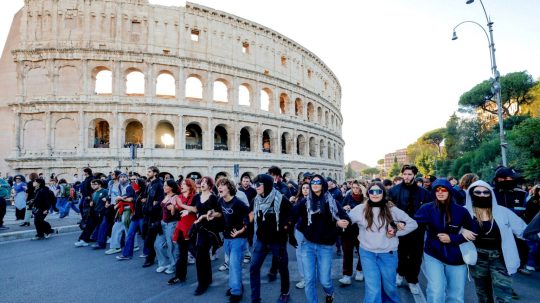
Rome, Italy, youth march, in this case without banners, past the Colosseum, Oct. 24, 2026.
In Spain, the demonstrations first kicked off on the crucial issue of housing. On Oct. 25, some 25,000 people marched in Madrid to demand an increase in and more security with pension payments. In Barcelona, young people battled with police.
In neighboring Portugal, people set up encampments in Lisbon and Porto to protest the lack of affordable housing. Police, some with dogs, attacked the campers and arrested 25 protesters in Rossio Square in central Lisbon.
The struggle exploded even in the small Balkan country of Albania, where the population is less than 3 million, and the people have been protesting the brazen attempt by some Trump relatives to buy an island and set up a tourist profit center. Now protesting for education, people poured into the streets of the capital, Tirana, on Oct. 25. They gathered in front of the Education Ministry and then walked to the office of Prime Minister Edi Rama, setting on fire chairs he had placed in front of it as an invitation to a dialogue with the government.
France’s history of class struggle
In the development of a class-struggle view of the world, Karl Marx often used revolutionary developments in France as a point of reference. Among European countries, France was where the class struggles led to the most dramatic changes.
The 1789 bourgeois revolution overthrew the monarchy without the compromises with the old rulers that were typical elsewhere. The 1871 Paris Commune provided the first example of the working class taking over in Europe, and it was an example used for future revolutionary theory.
And more recently in 1968 in France, the mostly middle-class university students began a struggle for broad university reforms. These protests led to open battles when police attacked the occupation of universities, which in turn led to a months-long general strike of 10 million workers.
While 21st century France is not the big empire France was in the 19th century, the knowledge that many of the protesters have of those historical developments still has an impact. Many people know that a struggle that begins with demands for more books and teachers may lead to a battle for a new society.
The imperialist rulers of Europe, faced with a loss of their ability to pillage the Global South, opted in the past few years to prepare for war and to diminish the living conditions of the workers. They no longer make the kinds of concessions that kept Europe relatively stable for decades. The workers have finally begun to fight back.
Those conditions prevail not only in Europe but also in the United States, where another escalation in the war in West Asia is on the agenda. So it is reasonable to ask: Will the uprising that began in Europe, influenced by the resolute struggles of the Global South and especially now in West Asia, also spread to the United States?
For the sake of humanity, may the answer be yes.


