

By Manuel Raposo
October 31, 2026
Lisbon, Portugal
Raposo is a Marxist analyst and editor of the Portuguese web periodical found at jornalmudardevida.net, where this article was published on Oct. 27, 2026. Translation: John Catalinotto

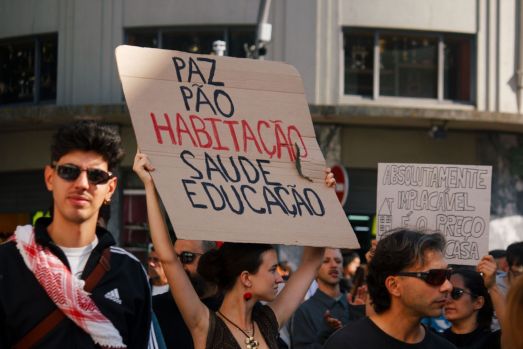
Higher minimum wage, peace, bread, housing, healthcare and the right to organize. Lisbon, Oct. 17, 2026. Photo: Avante
October 27, 2026
War, militarism, energy shortages, famine, economic collapse, social upheaval, environmental crisis: Everything that had been simmering beneath the surface and seemingly scattered across all European countries has suddenly coalesced into a multinational mass movement.
Under the combined effect of all these factors, Europe has entered a whirlwind that is challenging established governments and routine policies that once seemed unquestionable. These are the first tremors of a political earthquake drawing its energy from the social collapse that has built up over the years.
Europe, the weak link
European imperialism is today the weakest link in the U.S.-Europe-Japan imperialist triad; an imperialist power in free fall. Only this perspective allows us to see the full significance of the events as a whole and the potential contained within these movements.
The different origins of the struggles and the diverse demands raised all share the same underlying target: the established social, economic and power system — even if this does not explicitly stand out as a positive demand the protests have raised. But one thing is clear: “This is not what we want,” say the protesters.
The movements rightly attack the governments and the policies that these governments have implemented. But what is truly at stake is the entire economic, political and social system. It is inevitable that this reality will become clearer in the minds of workers.
Triumphant capitalism, repeatedly presented as the only possible system for organizing social life, reveals itself to be a predatory system, exploitative to the extreme, ruthless in its pursuit of immediate profit — and therefore incapable of meeting basic social demands, let alone future social needs. This reality is glaringly obvious to the masses, even those who do not take to the streets. This explains the widespread popular support for the protests and the fear on the part of those in power that the movement will spread like an oil slick.
From time to time, there have always been outbursts in various countries across the continent. What is new now is that the street actions are all happening at once. This is a factor of the utmost importance that amplifies them and gives them the character of a transnational movement.
Two new developments: (1) Young people are taking the lead −− this is the response to the reality that the life offered to the new generations is worse than that of their parents and that their future is blocked. (2) The energy of the current protests challenges the ritualistic demonstrations that those in power have absorbed without difficulty over the years.
Disorder — whether peaceful or violent — challenges an order that seemed set in stone. It is no coincidence that, in France, Macron has banned demonstrations not organized by labor unions. In Portugal, the government and the police resort to pre-constitutional laws to disperse popular gatherings.
Common ground
Housing, the welfare state, healthcare, education, employment, wages, pensions, etc., as well as rampant speculation and corruption in power — all these issues come to the surface in an apparent amalgam of protests.
The fact is that all these problems are shared throughout Europe, even if they are experienced with varying intensity from country to country. That is why, all of a sudden, France, Belgium, Spain, Portugal, Italy, Greece and Albania find themselves shaken by the same kind of upheaval.
And not only that: Tunisia, on the other side of the Mediterranean, is raising the same issues, reminding us of how the Arab Spring of 2011 demanded, in unison, popular freedoms and better living conditions.
The risks of “imitation” and “importation” of the protests — the specter that all government leaders have invoked, trying to portray the movements as a conspiracy coming from who knows where — stem from this common ground of problems. It is neither imitation nor importation. It is unity in diversity.
The proposal for an Iberian strike in defense of the right to housing, launched by Spanish and Portuguese protesters and already supported by Spanish labor federations, reflects this unity.
“Thank you, Porto,” read a small sign in Lisbon hailing the pioneering initiative of the protesters in Porto. Well said. For the same reasons, we must say Thank you, France — Thank you, Albania — Thank you, Tunisia.
Radical and mass-based
Radical mass action opens up paths, not closes them, contrary to the conformist notion — always being peddled — that radicalism is the domain of small groups, that radicalism “alienates” the masses.
From what we’ve seen, it is precisely because they confront the political root causes of social problems (housing, education, rising costs, speculation, corruption) and point the finger at the established powers that street protests have been drawing more people willing to protest, as they see that protest gains strength and overcomes fear. Daring to fight encourages daring to win.
The chaotic violence carried out by some sectors of protesters (particularly evident in France and Albania) can weaken the movements’ causes when directed against the wrong targets. But it does not strip them of their legitimacy. Let us remember that the demonstrations began as peaceful and moderate and became more extreme in response to police violence by the authorities; and that most of them, including those in France, are taking place peacefully.
Acts of popular violence, even when indiscriminate, must be seen as the result of long-suppressed social pressure — which erupts haphazardly due to a lack of political direction and a political solution commensurate with the accumulated problems.
In a report from Paris for a Portuguese television station, a journalist asked a passerby what he thought of the acts of violence. His reply: “People are outraged, ma’am.”
The element of surprise
Both the national authorities and the opposition, including those on the left, were caught off guard by the events.
The official left has limited itself to proposing palliative measures. It lacks a program to address the underlying problems.
In the case of housing, for example, such a program would require tackling the issue of land ownership, with the nationalization of a significant portion of private property and the expropriation of real estate funds. In the case of healthcare, it would entail the socialization of public health services. In the case of education, it would lead to a complete overhaul of the education system with a view to planned economic development and a corresponding employment policy.
The same can be said about mobility and transportation systems — which are essential for the working population — and about environmental protection policies.
The various national authorities, even more so, also have no answer to any of the issues at stake.
For this very reason, the impasse is explosive. With no way out, the forces of resistance are building up. Even if these current movements were to subside and die out, the reasons for discontent and the conditions for new mass protests persist and tend to intensify the forms of struggle.
We must, therefore, make the most of these movements: Demonstrate the power of mass actions to confront governments and repressive forces; prove the vulnerability of those in power to collective and street actions; and emphasize that years of parliamentary activity achieve far less than street protests do in a matter of weeks.
Let us recall our two [Portugal’s] recent general strikes — both in terms of their immediate practical success (the defeat of the labor law amendments) and in terms of how much still remains to be done to change the country’s political course.
A united rightwing
Right-wing forces of every stripe found themselves caught between the determination of the movements and the urgency of restoring the state’s authority shaken by the streets. The far right, so vigorous in its criticism of the established powers, joined them in unison. And vice versa. This proves that mass radicalism is the appropriate response against both the right and the far right combined.
Without even a hint of a political response, the entire rightwing converged on a single goal: to dismantle the protests by force and to discredit the reasons behind them. Public order was their sole motto.
Faced with demonstrations for the right to housing, Prime Minister Montenegro believed the best way to respond to the protests was to accuse the political forces supporting them of being “opportunists” and “selfish.” Young people “are not willing to make sacrifices,” said the president of the Housing Institute.
The right and the far right unanimously urged the government to be ruthless in its crackdown. “Put them up against the wall!” bellowed a member of the National Assembly, in an outburst à la [former Chilean dictator Augusto] Pinochet. The entire rightwing sang from the same hymn sheet, blaming immigration for the housing shortage.
In France, where the movement originated with high school students protesting the deterioration of education, [ultrarightist] Marine Le Pen had to show, at first, that she “understood” the protesters and their “legitimate social demands,” only to later accuse the far left and France Unbound (LFI) of “poisoning” the movement. She’s now seeking to capitalize politically by presenting herself as the force capable of restoring order.
In Spain, where the housing crisis has sparked strong popular movements since September, the right and the far right have joined forces to block the timid reforms proposed by the government, which was pressured by the protests. The responses from across the rightwing boiled down to calling for repression of street protests, blaming immigration for the housing shortage and proposing severe penalties against the occupation of vacant homes. Repression for some, free rein for speculation for others.
What is the way out?
The movements that have sprung up, on their own, do not seem to have a political way out. They lack the direction and level of organization needed to force governments to face dramatic choices. Despite all the vigor put into the struggles, this has not yet happened.
Aware of this, the various national authorities refrain from making concessions, instead relying on police force to contain the movements, quell violence, amplify and condemn “the chaos,” appeal to the conservatism of the segments of the population that remain passive and wait for the energy of the protests to run out.
However, the energy, persistence, widespread nature and national diversity of the ongoing protests in Europe are signs that conditions are ripening for social movements — particularly those of the working class — to shift from the defensive stance in which they have been mired to an offensive one — even if this process, due to circumstances, is naturally gradual.
The signs emerging from these class confrontations indicate that the search for social compromises is doomed to failure. Under these conditions, workers, labor unions and popular movements face the urgent need to formulate common strategies of struggle that place them at the forefront of all social movements that, in one way or another, confront the power of capital and the power of monopolies.
Changing course
The objective conditions — so often invoked to justify defensive and retreatist political positions (focused purely on defending “hard-won gains,” as if they were secure trenches) — are currently favorable to the development of radical mass actions.
Favorable objective conditions mean this: Contemporary imperialist capitalism has entered an era of permanent, systemic crisis with no possible resolution, which unfolds into multiple crises with a common root, driving Western societies to the brink of collapse.
Radical mass actions, that is to say: The response to the situation experienced by millions of people (war, militarism, fascism, extreme exploitation, social degradation at all levels) has no choice but to attack the very foundations of the social system.
Moving beyond capitalism in crisis is the only response to the crisis of capitalism, as Samir Amin rightly emphasized in a 2011 essay aptly titled “The Implosion of Globalized Capitalism — The Challenge for the Radical Left.”
Current events are changing the social landscape in Europe. The balance of class forces is shifting. The task of the militant left is to define political strategies that not only keep pace with the more or less spontaneous movements that are unfolding but, above all, stimulate the construction of a path of anti-capitalist struggle that empowers the working and popular masses, a course of action that brings together the different movements — in all their diversity of origin and purpose — toward a common goal.


