
Elections won’t save us: Look to the youth of Europe
By Sara Flounders
November 5, 2026
This is a talk by Sara Flounders as a participant in the International Manifesto webinar on Oct 31. For a link to the whole webinar see: https://www.youtube.com/watch?v=-d5MIMhQvZ4
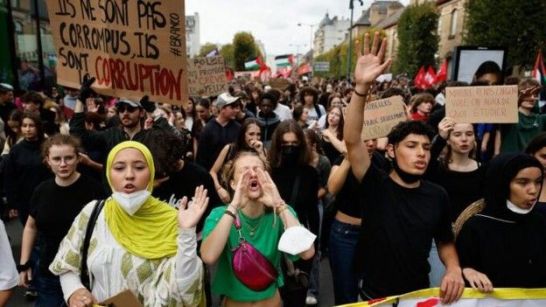
Students protest in France, Oct. 17, 2026.
November 3 is described as one of the most consequential elections in U.S. history. That’s also how today’s International Manifesto webinar announcement framed it: Record stakes!
Let’s look at this. In my opinion, these elections are not the most consequential world event. What will this U.S. election fundamentally change?
Yes. Trump and this whole criminal administration are using every vicious tactic, from voter suppression, intimidation, Immigration and Customs Enforcement (ICE) agents at polling places, redistricting designed to knock out Black candidates and lists of voters to exclude. There are battles over mail-in ballots, with polling places closed and other sweeping restrictions on voting.
We must always defend the right to vote in Black and Brown communities. Always. That is not in question.
But what will this election really change?
There is turmoil in the ruling class with real pushback against MAGA and a growing search for alternatives. Politicians cannot vote their way out of the crisis they are facing. So how can this election solve the enormous problems facing U.S. imperialism — in decay, in decline?
The AI bubble
Many economic commentators now agree that the U.S. economy is facing a giant AI bubble with trillions of dollars in paper wealth ready to evaporate. Seven trillion dollars in projected data center spending — with little hope of generating profit to match the investment – exposes the systemic risk.
When economic bubbles burst there is an immediate scramble to transfer the losses away from shareholders and creditors onto the backs of the workers. Historic bailouts for the banks have involved trillions of tax dollars.
This was the case with the bailouts in 2008 under President Obama that resulted in millions of layoffs, with 10 million families losing their homes through foreclosures and rounds of social cuts. It can happen again regardless of who wins this election.
Elections cannot solve structural problems
So what role do elections play? They are a legitimacy ritual during imperial decline: a spectacle, with domestic grievances, raised on a stage built on top of a structural reality no Congress can legislate away, including U.S. decline and the collapse of the U.S. position in West Asia. Plus the capitalist economic base is increasingly reliant on financialization and AI speculation — rather than production.
Neither capitalist party offers a path to reverse this. Both parties are financed by the same forces that profit from the current arrangement. The question elections actually decide is which constituency absorbs the costs of decline. And on the present evidence, it will be working people here and globally, not the corporations that engineered the decline.
Remember this: declining hegemons remain capable of immense destruction — precisely because they are declining.
The French uprising
So where should we be looking? Look to the youth eruptions across France, Belgium, Italy, Spain and now Germany. There are millions of people demonstrating — for the third weekend in a row — in hundreds of European cities, defying threats of repression and marching in 289 cities and towns in France alone.
What are their demands? Funds for education and healthcare. Higher wages. Affordable housing. A lower cost of living. This is a generational break with electoral politics because capitalist parties of left, right and center have all administered the same austerity budgets — and the same war budgets.
And notice who sparked the uprising in France. It was African, Arab and Muslim students from the suburbs of Paris and from former colonized “overseas” territories. Youth are enraged at their own conditions — in schools without desks, without teachers and at their governments’ support of Israel’s genocide against Palestinians. They are enraged at military spending and cooperation with the U.S. war against Iran and funding NATO’s proxy war in Ukraine.
Ten thousand demonstrators have been arrested. The French ruling class unleashed a massive, militarized police presence and broad curfews. Their corporate media used violence baiting to create a pretext for this repression. They are trying to break the unity of students and union workers, but so far they have not succeeded.
The organized working class has joined in. The Yellow Vests have joined in. Teachers and students struck together in Madrid. And now defending these angry, militant actions begun by youth, a general strike has been called for Nov. 5 in France, Nov. 12 in Spain and Nov. 20 in Italy. Each day of actions takes the struggle a notch higher.
Demands against war
On Oct. 30, dockworkers’ strikes in 22 countries were initiated by dockworkers in Genoa, Italy, a major port and strategic gateway to West Asia. Dockworkers and port unions across over 100 global ports staged a coordinated International Day of Action of Dockworkers and Port Workers to protest arms shipments and military spending and in solidarity with Palestine.
Here is what the corporate media will not tell you. Demands for social spending are demands against war. Every euro going to schools and hospitals is a euro not available to build missiles and drones — to arm Ukraine against Russia or to support the U.S.-Israeli war in West Asia and the genocide in Palestine.
Military spending — passed in legislatures almost without question — transfers wealth to the capitalists who own the arms industries — the military-industrial complex.
Elections can decide who wins and who loses among ruling circles. The eruptions from below reveal who refuses to accept the attacks and cutbacks that both corporate parties agree should be born by the workers and oppressed.
We should not claim these eruptions will succeed. No one can promise that. But this resistance is more politically instructive — for revolutionary forces — than studying the midterms!
France is a turning point
France is where class struggles have led to the most dramatic changes, again and again. In 1789, the bourgeois revolution overthrew the monarchy — without compromise. Off with their heads.
In 1848, the revolutions in France helped produce the Communist Manifesto. Think of young Karl Marx and Frederick Engels analyzing events — as the working class began to understand its own potential power.
The Paris Commune in 1871 was the first example of the working class taking power. Marxists, especially Vladimir Lenin, studied it for decades.
In 1968, university students in Paris began a struggle that led to a general strike of 10 million workers. French industry, transport, schools and factories were paralyzed for weeks.
Learn this lesson from history: A struggle that begins with demands for more books and more teachers could potentially result in a battle for a new society.
Why now? Why is this happening today? Because of uprisings in their former colonies, the imperialist rulers of Europe face a loss of their ability to pillage the Global South. They can no longer make the kinds of concessions to the workers that kept Europe relatively stable for decades.
And the workers have finally begun to fight back.
Those conditions prevail not only in Europe. They prevail here in the United States where another escalation in the war in West Asia is already on the agenda. Political movements are contagious. This upsurge may spread here. The conditions are remarkably similar. Events propel it.
Reform or revolution
Electoral gains of social democratic candidates are a sign of the change in consciousness. A decisive section of new workers are voting for socialism. End-stage capitalism has stolen the futures of young people. Young workers of every nationality and gender are rebelling against capitalism and increasingly against U.S. imperialism. These workers are not merely voting out of fear of Trump; they are voting against the capitalist system.
This struggle once again poses the question of reform versus revolution. In order for this struggle within the working-class movement to happen, there must be a strong force of socialists with a revolutionary orientation who are organized independently. The social democrats who get elected will not be able to accomplish anything unless there is class struggle with strikes, occupations and mass actions.
Consider Mayor Mamdani in New York City, who had 100 campaign promises to make New York City affordable. His election was propelled by outrage over Palestinian genocide and a reflection that young workers are anti-imperialist and want to be part of a world struggle. Democratic Socialists of America mobilized 50,000 door knockers, who spent hundreds of hours in their get-out-the-vote campaign.
After Mamdani won, the 50,000 activists willing to go into the streets were demobilized from fighting for a single one of those 100 promises, including free bus fares, saving public housing, controlling the police or controlling ICE.
Whatever DSA’s intentions were, the result was to disarm the working class. They made endless promises — but are shameless about delivering on any of them. They refused to use their elected positions to challenge power.
The great abolitionist Frederick Douglass taught us that power concedes nothing without a struggle. It never has, and it never will. What do the Democratic Socialists really have to offer? They mobilized nothing to initiate a class fight for what they promised. People want change — but the challenge is to show that change is impossible through a voting booth alone.
In Europe, a more powerful challenge has emerged. Youth are not looking to elections for change. They have far more experience than social democrats in the service of the empire.
What we know
No matter who wins or loses the Nov. 3 election, the giant AI bubble will burst. It is inevitable. Unstoppable, regardless of who holds Congress, the Senate or the White House. The impact will be devastating, horrific and life-threatening.
We know the wars will continue — the U.S.-backed, all-out Zionist war on Palestine, the NATO war on Russia, the war on Iran — the stage is set for a horrific round of a major U.S.-Israeli war. These are certainties. Elections do not alter them.
The imperialist rulers of Europe cannot make concessions – not if they are going to fund armies and arm dictatorships. They can prop up genocides. They always find money for war.
So if we are thinking of change — look to France. Look to Spain, Belgium. Italy, Albania, now even Germany. Millions of youth are placing no expectations in waiting for an election.
Let’s start by looking at what is actually going on in the world. Not just the U.S. electoral cycle. U.S. elections are imposed on the world as if they matter — as if the planet holds its breath. We are merely spectators. We have no say in who runs.
But there is a message erupting from below — across Europe, sweeping Asia, sweeping Africa. A message that will change far more than staged elections here, regardless of who wins or loses a midterm. The focus on elections in this country is performative theater. It is not intended to challenge anything of substance.
What is unfolding in France has revolutionary implications — for Europe and for the global struggle. It has reached a tipping point. Massive police presence and new curfews will not stop it. Examine the social relations that hold this system together — and you will find them cracking.
A struggle that begins with demands for desks and teachers can become a battle for a new society. The bourgeois rulers know this. That is why they arrest tens of thousands of protesters. That is why they are afraid. Let’s study that. Build that. Can it happen here?
The grievances driving the French, Belgian, Italian and Spanish youth are not uniquely European. Those youth protests are driven by crushing debt, unaffordable housing, precarious work, degraded public services, rage at complicity in genocide and war and fear that climate change will deny them any future.
The United States has the same dry kindling, arguably drier. Youth in the U.S. carry more debt than ever, face worsening healthcare and employment and transit precarity and have watched the same bipartisan war budgets pass.


You must be logged in to post a comment.