
Europe is protesting – workers and students are fed up
By G. Dunkel
November 5, 2026
Not every protest in every country has the same target. Not every country has had protests. Some sections of the working class in countries with protests have not taken to the streets. Still, millions of workers in Europe have made it clear that they are protesting to solve their problems, not waiting until they can vote on candidates who might make the changes they want.
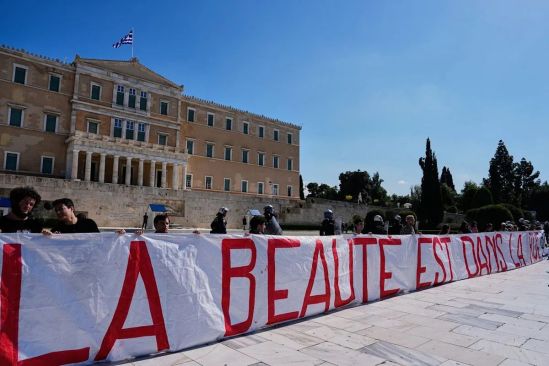
Rally organized by teachers and students demanding improvements to education and measures to address the rising cost of living in Athens, Greece, Oct. 21, 2026. The banner in French reads “Beauty is in the street.” AP Photo: Thanassis Stavrakis
It is clear when this tsunami of protests started. Teachers in a Paris suburban school (many of the suburbs of Paris are working-class, immigrant communities) went on strike mid-September over poor working conditions, which are poor learning conditions for their students.
To support their teachers, the students struck and blockaded their school, which quickly drew the attention of the authorities and fellow students in the Paris suburbs. Students in the suburbs were not only paying attention, they began to actively support their fellow students, since they had the same grievances.
National mobilizations began on Oct. 1. Schools all over France were struck and blockaded, and the struggle drew in university students, becoming deeper and wider as October days passed.
Protests escalated on Oct. 17 when student organizations joined nationwide demonstrations called by trade unions and the yellow vests movement against the cost of living and the lack of available housing and public services. About 800,000 people participated, according to organizers, in marches all over France.
There have been two more successive weekend demonstrations, drawing about the same number of participants, according to organizers, but with a broader range of progressive organizations and associations.
The French ruling class has militarized the police, who are using harsh tactics — rubber bullets to take out eyes, stun grenades to mangle limbs, mass baton charges — to try to break the dynamic appeal of these protests, but it does not appear to be working. The political system of France is in danger of tottering. (Libération, Oct. 31; Le Monde, Oct. 31)
Greece
Greece has had major economic difficulties. Its economy collapsed in 2010 after the Great Recession of 2008 sharply reduced global credit and demand, hitting Greece’s key industries — tourism and shipping. The Greek economy has recovered, but it still operates in austerity mode, including underfunding education.
Greece’s education unions were very impressed with the struggle of France’s students and teachers. Thousands of pupils, university students and teachers marched across Greece on Oct. 21 to demand improvements to public education and protest rising living costs.
The marches and protests took place in Athens, Thessaloniki, Patras and Heraklion, as well as a number of smaller cities. They were supported by the Confederation of Civil Servants’ Unions and the major teachers’ unions. They also involved ongoing school occupations across several regions.
To make their solidarity with the French students clear, the protesters carried French-language banners and sang French language, anti-fascist songs. They also stretched a banner in Syntagma Square in front of the Parliament Building that read “La Beauté est dans la rue.” (Beauty is in the streets.)
Police in Athens and Thessaloniki detained dozens of people.
One unusual feature of the protests in Greece is that they opposed the early release of Ilias Kasidiaris, the leader of the fascist group called the Golden Dawn. A Greek court has established that Golden Dawn is a criminal gang, responsible for deadly attacks on migrants and political opponents. (tinyurl.com/47kh6uaf)
Germany
Over 160,000 people demonstrated in 30 German cities against government policies on Oct. 31. The demonstrations were organized by the youth group “GenZ regelt!” (Gen Z has got this!) They rallied to demand improved public education, affordable housing and aggressive climate action, while voicing strong opposition to social spending cuts and growing military rearmament, in particular the establishment of compulsory military service.
In Berlin, around 5,000 demonstrators assembled near the Brandenburg Gate carrying banners condemning Chancellor Friedrich Merz and calling for his resignation.
There were scattered instances of protesters carrying weapons or throwing rocks, which met with a harsh police response. Given what has happened in France, stores closed up early and put up plywood or metal curtains. (Libération, Oct. 31)
Italy
The march against wars and rising living costs began peacefully on Oct. 31 in Milan, but after a while masked protesters threw stones, paving blocks and other objects at riot police and set fire to barricades made from bar tables.
This emptied Piazza del Duomo and a luxury arcade in the city center that would usually be full of shoppers. Police used water cannons and tear gas to disperse the crowds.
At least two police officers were injured, and about 50 demonstrators, many of them minors, were detained, the Italian LaPresse news agency reported.
Italy’s Prime Minister Giorgia Meloni condemned the violence. “Demonstrating is a right. Setting our cities ablaze is not,” she wrote on X, blaming “hooligans who exploit demonstrations to sow chaos.”
However, Milan’s center-left mayor, Giuseppe Sala, said: “The reasons for the protests were understandable. The violence against law enforcement and serious damage to the city are not justifiable.” (tinyurl.com/3abf9h3v)


You must be logged in to post a comment.