
U.N. votes to end blockade against Cuba over U.S. opposition
By Brenda Ryan
November 6, 2026
Defying intense pressure from the United States, the United Nations General Assembly voted overwhelmingly in support of a resolution to end the U.S. economic, commercial and financial embargo against Cuba, with 130 countries in favor, 17 against and 25 abstentions.
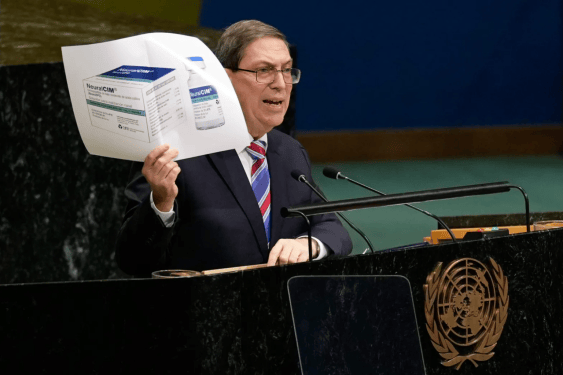
Cuba’s Minister of Foreign Affairs Bruno Rodríguez Parrilla speaking at U.N. General Assembly session, holding a picture of Cuba’s NeuralCIM, Oct. 28, 2026.
This was the 34th consecutive year the General Assembly has taken up the resolution. Initially, Israel had been the only country routinely voting with the U.S. In 2024, the two countries cast the sole NO votes with Moldova abstaining. Last year, the U.S. government waged a campaign to push countries to change their positions, and seven voted NO, 12 abstained. The Trump Administration escalated its campaign this year.
Cuba’s Minister of Foreign Affairs Bruno Rodríguez Parrilla stated in a post on X that U.S. Secretary of State Marco Rubio and U.S. Representative to the U.N. Mike Waltz threatened to impose tariffs, suspend cooperative programs, deny visas to government officials and support opposition forces in upcoming elections if countries did not change their vote on the resolution. (Oct. 21)
The General Assembly debated the resolution, introduced by Cuba, on Oct. 27 and 28. Representatives from member countries expressed solidarity with Cuba, noting the tremendous suffering of the Cuban people since the U.S. imposed a fuel embargo in January.
Speaking on behalf of the African Group, Namibia’s Permanent Representative to the U.N. Penda Naanda called for an end to the blockade and the removal of Cuba from the U.S. list of states alleged to sponsor terrorism. “This General Assembly cannot stand idle and watch the suffering of the people of Cuba indefinitely,” he asserted. (misiones.cubaminrex.cu, Oct. 27)
Citing the long history of Cuban solidarity with Africa, Naanda noted Cuba backed the people of South Africa in their struggle for liberation, Cuban doctors worked beside West African health workers during the Ebola outbreak in 2014, and Cuban medical brigades and teachers continue to serve across the continent.
‘There is no blockade’
In his address to the General Assembly on Oct. 27, Waltz arrogantly declared: “There is no blockade. A blockade is a ring of military ships around an island. It doesn’t exist.” (bellyofthebeastcuba.com, Oct. 27)
The U.S. has in fact imposed a trade embargo against Cuba since 1962, as the U.S. State Department notes on its website. On Jan. 29, President Trump issued an Executive Order asserting that Cuba “constituted an unusual and extraordinary threat” to U.S. national security and foreign policy and declared that the U.S. may impose tariffs on goods imported into the U.S. by any country that directly or indirectly sells or provides any oil to Cuba. The U.S. subsequently intercepted and seized oil and biodiesel shipments headed to Cuba. (whitehouse.gov)
Waltz claimed that the Cuban government was preventing aid shipments from reaching the people by routing them through Grupo de Administración Empresarial (GAE ), which he referred to as a military conglomerate. Cuba says the organization was created during the Special Period (1991-2000) in response to the blockade to provide material and financial contributions to programs throughout the country. (Granma, June 2)
Waltz also denounced Cuba’s medical internationalism program of sending doctors and nurses to assist other countries as “slave labor.”
The Cuban delegation pounded on their desks, and Parrilla called for a point of order, declaring that Waltz was lying and offending the dignity of the people and government of Cuba. Parrilla walked to the front of the room and stood in front of Waltz, who angrily shouted: “You understand who you’re dealing with? This is America. Back up. Sit down.”
Blockade ‘silently kills’ like never before
Parrilla addressed the assembly the following day ahead of the vote. He said Waltz’s statement, “This is America,” reflects a worldview that treats and considers the whole planet as if it were part of U.S. territory. This, he stated, is the United Nations, the capital of an international order that should be based on international law and the U.N. Charter.
The U.S. is waging an economic war against Cuba with the aim of domination and regime change, Parrilla said. “This aggression includes a fuel blockade — tantamount to a naval blockade — which constitutes an act of war, an act of collective punishment and an act of genocide, all of which are prohibited under international law.” He called it a “medieval-style siege.”
Parrilla held up a digital counter ticking up the amount of damage inflicted by the blockade since the Assembly session began, noting that it totaled more than $22.9 million.
“The blockade silently kills and punishes our population like never before,” he said. “Since the beginning of the maximum pressure policy, our infant mortality rate has doubled. They are not statistics. They are not figures. They are children. They are lives cut short at birth with immense pain for those families.”
Parrilla noted that 70% of essential medicines are unavailable, and 100,000 people, including 12,000 children, are waiting for surgeries. He said the blockade prevents Cuba from purchasing Eli Lilly’s lung cancer drug Pemetrexed and prevents Americans from obtaining Cuba’s NeuralCIM for treatment of dementia and other neurological conditions.
“The few draconian and burdensome exceptions to the blockade — granted through highly restricted government licenses — do not prove that the blockade does not exist; in fact, they prove the exact opposite,” Parrilla stated.
Waltz said that Trump has committed $100 million in food and medicines that is passing through the Catholic Church. Parrilla noted that sum is equivalent to the economic damage caused by the blockade in just five days and would only be enough to fund limited electricity generation for a mere two weeks.
In his opening remarks, Parrilla requested the removal of Orlando Gutiérrez-Boronat, who is number 52 on Cuba’s list of people wanted internationally for acts of terrorism. Waltz told the Assembly that Gutiérrez-Boronat, Secretary General of Assembly of the Cuban Resistance, was a guest of the U.S. delegation.
The 17 countries voting against the nonbinding resolution to end the embargo were Argentina, Bosnia and Herzegovina, Colombia, Costa Rica, Czechia, Ecuador, Hungary, Israel, Lithuania, Morocco, North Macedonia, Paraguay, Slovenia, Trinidad and Tobago, Ukraine, United Arab Emirates and the United States.
Those abstaining were Albania, Bahrain, Bulgaria, Chile, Croatia, Dominican Republic, Estonia, Germany, Greece, Guyana, Haiti, Honduras, Italy, Jamaica, Latvia, Montenegro, Netherlands, Palau, Peru, Poland, Qatar, Republic of Korea, Republic of Moldova, Romania, and Solomon Islands.
Numerous U.S.-based Cuba solidarity activists attended the debate and applauded the outcome. After the vote, Rodríguez met them in the U.N. lobby and expressed gratitude for their support.


You must be logged in to post a comment.