
U.S. environmental deregulation vs. China’s climate progress
By Betsey Piette and Lyn Neeley
November 11, 2026
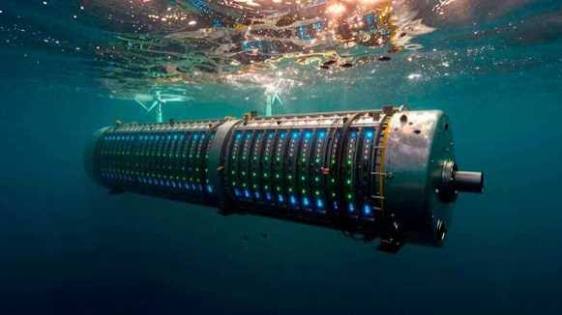
China’s underwater data centers cost less than half of land-based facilities.
While most corporate media were focused on the midterm elections and whether the end results would weaken President #47’s control over Congress, the MAGA administration was taking quiet but rapid steps to weaken or repeal significant regulations designed to protect workers’ safety, human health and consumer safeguards and mitigate climate-warming pollution impacting the food we eat, the air we breathe and the water we drink.
This is all happening as global warming has reached record levels and where almost nowhere on the planet are people safe from its impact.
It took decades of people struggling to get federal environmental protection statutes passed in order to lessen environmental harm. In his second term, Trump has prioritized dismantling these protections.
Starting with his January 2025 inauguration, #47 made it clear that he is president of the billionaire class and will accept any bribes offered to him to clear the way for companies to increase profits at the expense of working and poor people.
On his first day back in office, Trump ordered Washington’s second withdrawal from the 10-year-old Paris Agreement, which aimed through national climate plans to prevent global temperatures from rising more than 1.5 degrees Celsius above pre-industrial levels.
Executive orders repeal 31 environmental protections
Since day one of his second term, Trump has signed executive orders that restrict or fully repeal 31 environmental and consumer protections put in place by previous administrations. Claiming his actions will “roll back trillions [of dollars] in regulatory costs” and boost the U.S. economy, Trump moved rapidly to weaken or repeal regulations that protect human health and the environment.
Other actions impacted laws designed to improve energy efficiency for consumer products and limit emissions of climate-warming pollution. (epa.gov/newsreleases) Altogether this amounts to the biggest deregulation taken under the “oversight” of the Environmental Protection Agency in U.S. history.
Increased fracking on public lands
Since March 2026 Trump has rescinded regulations limiting greenhouse gas endangerment and vehicle emissions. In June he increased access to public lands for oil and gas drilling, overturning restrictions imposed by Joe Biden’s administration. Also in June, provisions for climate-related disclosures for public companies ended.
In September, Trump ended greenhouse gas reporting. He overturned Biden regulations concerning stricter mercury pollution standards. Bans on hydrofluorocarbons were phased down, and the definition of “harm” under the Endangered Species Act was changed to weaken its provisions.
Always a climate-warming denier, in April 2025 Trump launched a legal attack on states’ authority to set climate change policy, directing the Department of Justice to challenge a wide range of state laws and regulations. His executive order also targeted state-led lawsuits against fossil fuel companies over damages they caused. (stateline.org, April 9, 2025)
Now Trump is downplaying the need for oversight of artificial intelligence — not surprising since many of the capitalists who control AI were among major donors to his campaign. The significant popular pushback against AI data centers played a deciding role in some midterm elections. Many people hope this movement will continue to exert influence over federal and state legislatures going forward.
Will a congress under Democratic Party control push for reinstatement of the regulations Trump has gutted? Will it restore funding to promote solar and wind power? Will the new Congress stop the expansion of drilling and mining on lands of Native nations and national park lands and other measures that have threatened historically protected land areas?
All this remains to be seen. However, what is known is that when a government is determined to undo the harm of decades of pollution, it can be accomplished. A prime example is the government of the People’s Republic of China.
China powers a global green transition
China’s rapid industrial growth between 1978 to 1999 was marked by hyper-industrialization, with heavy reliance on burning coal for power. This resulted in intense air and water pollution by 2013. Hazardous pollution levels in Beijing reached 17 times World Health Organization guidelines. Over 60% of the groundwater in China’s major cities was classified as bad or very bad. Roughly 16% of China’s agricultural land had heavy metal soil contamination.
China could have continued on this path — much as the U.S. has — but public outrage and staggering public health costs led the government to declare an official “war on pollution” in 2014. By shutting down coal-fired heating, imposing strict emission caps and accelerating clean energy adoption, within a decade China successfully reduced air pollution by over 70%.
But they didn’t stop there.
For decades, China’s socialist government has invested in renewable energy, preparing for a carbon free, clean energy infrastructure. Carbon dioxide (CO2) emissions plateaued and began to decline by 2024. China surpassed its ambitious Paris Agreement climate goals sooner than expected: peak (CO2) emissions before 2030 (when global CO2 emissions reach their highest level) and carbon neutrality before 2060 (when CO2 released in the atmosphere equals that being removed).
China defies U.S. climate denial
Today, “China leads nations with new climate plans, defying U.S. climate denial,” Reuters reported in September 2025. “China’s reduction target marked the first time the world’s biggest emitter pledged a cut in emissions, rather than just limiting their growth.”
In June 2026, the United Nations Environment Program reported, “China achieved its original 2030 Nationally Determined Contribution (NDC) target for wind and solar capacity years ahead of schedule.”
By 2025, renewable energy was 60.7% of China’s total installed power capacity, which met its 2030 target for renewable energy well ahead of time. China has more wind capacity than the rest of the world combined and is home to six of the world’s largest wind turbine manufacturers. By July 2026, solar power became China’s largest source of power generation, surpassing that of coal-fired power for the first time.
Half of the world’s ten largest dams are in China, including the Three Gorges Dam, which is presently the world’s largest dam and greatest single producer of hydroelectricity.
How did China become the world’s green technology leader?
In China, the socialist state controls key sections of the economy and infrastructure through State Owned Enterprises (SOEs). SOEs include banks, finance, railroads, telecommunications, airlines, dams, technology, all raw materials and rare earth minerals, military industries, energy and aerospace. SOEs keep production costs low. Instead of going for corporate profits, the wealth they generate lays the basis for further development, prioritizing meeting people’s needs and improving the quality of life.
State centralized planning, subsidized research and investment in science education, technology, engineering and mathematics have aided China’s rapid transition to becoming a dominant global force in green technology. The number of clean energy patents filed by China rose from 18 in 2000 to over 700,000 by 2024 — that’s over half the world’s total.
Underwater data center
China built the world’s first underwater data facility fueled by nearby wind farms. Operating underwater eliminates the cooling needs for land-based facilities and has near-zero freshwater consumption. It will deliver data to Shanghai in 0.5 milliseconds.
China Daily in August 2026 noted, “China has become one of the world’s largest exporters of new energy equipment and a leading provider of carbon neutral engineering technologies and solutions.”
China produces about 80% of the world’s solar panels. It provides over 70% of exported electric cars and 98% of the world’s electric buses sold globally. The Chinese EV company BYD (Biyadi), has a battery that can be charged in five minutes, and the car it powers can then be driven for about 250 miles.
Support for socialist Cuba
In the Morning Star newspaper (April 16), Carlos Martinez describes how China has helped Cuba move towards energy sovereignty and its green transition. “By 2028 they plan on completing 92 solar parks. Last year, Chinese solar exports to Cuba rose to $117 million, up from $5 million in just five years. It’s one of the most rapid energy transitions ever achieved by a developing nation.
“Ten thousand photovoltaic systems have been donated for rural homes, maternity wards and health clinics. Five thousand solar kits installed across 168 municipalities are keeping medicines refrigerated and families powered through the blackouts.” Martinez argues that “this is what South-South cooperation looks like in practice: technology, financing and humanitarian assistance with no conditionalities, no structural adjustment, no strings attached.”
In “Around the world, China is turning on the lights,” (Workers World, Dec. 5, 2025), G. Dunkel reports, “Solar panel imports from China into the African continent jumped 60% in the 12 months preceding June 2025, setting a record that could transform many of the countries involved.”


You must be logged in to post a comment.